

When sourcing beer from a manufacturer, how much shelf life should remain for it to sell? Distributors are often less concerned about whether the beer has expired upon arrival and more concerned about whether, after the goods enter the warehouse, there will be enough time to distribute them to retail outlets and complete sales. The same batch may sell through quickly at a high-volume store, while newly developed channels may take months to move it. So a reasonable receiving threshold cannot be based only on a percentage such as “two-thirds of the shelf life remaining”; it should be calculated based on average daily sales, current inventory, and channel requirements.
First, distinguish between meeting shelf-life requirements and being suitable to receive
To assess whether a batch of beer is worth accepting, consider at least three factors: the shelf life stated on the label, the latest receiving date allowed by the channel, and consumers’ freshness expectations at the time of purchase. A product being within its shelf life does not mean a retail chain will accept it, nor does it guarantee enough time to sell it afterward.
For example, even if the requirement is that at least two-thirds of the shelf life remain, the saleable days will differ depending on the product’s total shelf life. For distributors, the remaining percentage is useful for initial screening, while the remaining days are what matter for calculating inventory turnover. Whether a shipment is acceptable also depends on the contract, product label, and actual storage and transportation conditions.
Different beer styles should not be subject to the same threshold. Products stored at ambient temperatures differ in storage, transportation, and sales pace from fresh beers requiring cold-chain distribution and unfiltered products. Flavor may also change over time and depending on storage conditions, so “not expired” does not mean “unchanged.”
Turn the receiving threshold into an inventory calculation
Calculate each SKU separately rather than averaging across all beer products. A basic formula is:
Minimum remaining shelf life upon arrival = (saleable old inventory expected on the delivery date + quantity in this shipment) ÷ conservative average daily shipments + days reserved for channel sales + risk buffer days.
Use normal sales data to calculate average daily shipments, excluding unusual fluctuations such as one-off group purchases or large-volume stock loading. For new products without historical sales data, refer to small-scale trial sales of comparable products rather than assuming they will sell as quickly as established bestsellers.
- Saleable old inventory: Inventory of the same SKU expected to remain unsold when the new shipment arrives. It is generally sold first.
- Time reserved for channel sales: Includes delivery, retail sales, and the channel’s remaining-shelf-life requirements. If the retailer requires a minimum number of days of shelf life remaining upon receipt, factor in delivery time along with that requirement to avoid double-counting.
- Risk buffer: Allows for factors such as declining sales, delivery delays, and uneven sales across stores. Set it according to actual channel conditions; it is not a universal standard.
This calculation gives the remaining shelf life at the time of delivery acceptance. If the manufacturer provides the remaining shelf life at the time of quotation or batch confirmation, subtract the transportation and receiving wait time. A recent production date does not automatically mean sufficient shelf life will remain when the goods reach the warehouse.
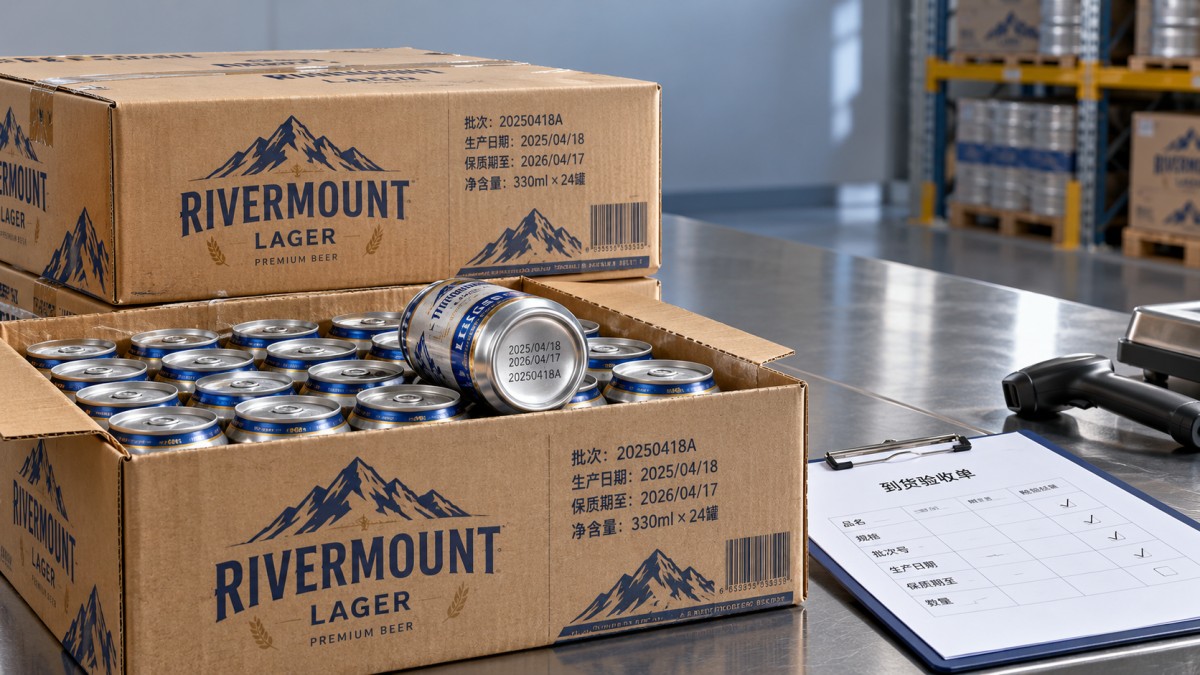
Example calculation: 120 days remaining may still not be enough to sell
The following is a calculation example, not a universal industry threshold. A certain beer SKU is expected to have 300 cases of old inventory upon arrival. The planned order is 900 cases, and the conservative average daily shipment volume is 20 cases. Allow 45 days in total for delivery, retail sales, and channel requirements, plus a 15-day risk buffer.
The minimum remaining shelf life required is therefore: (300 + 900) ÷ 20 + 45 + 15 = 120 days. If the manufacturer can deliver a batch with only 100 days of shelf life remaining, it is not suitable to accept the original quantity, even though the product is still within its shelf life.
In this situation, you do not have to choose only between accepting and rejecting the shipment. You can also calculate the maximum order quantity:
Maximum order quantity = (remaining shelf life upon arrival − time reserved for channel sales − risk buffer) × conservative average daily shipment volume − saleable old inventory expected on the delivery date.
Using the figures above: (100 − 45 − 15) × 20 − 300 = 500 cases. Rather than accepting all 900 cases at once, negotiate a smaller quantity, split the delivery into batches, or wait for a more suitable production batch. If the result is zero or less, current inventory has already used up the available sales window, so replenishment should be postponed.
Also check whether old inventory can be sold in time. Sufficient shelf life on the new shipment does not resolve the problem if an older batch is already approaching the channel’s rejection date.
Recalculate for the off-season, promotions, and new products
An average of 20 cases sold per day during peak season does not mean that the same pace will continue in autumn. Sales of holiday gift sets, new fruit-flavored beers, and regional trial products are often concentrated in a particular period. Before ordering, run a stress test using a lower sales estimate: if sales decline, can the goods still be sold before the channel’s cutoff date?
For promotional orders, distinguish between distributor shipments and sell-through at retail. Shipping the goods to stores all at once may make inventory turnover look fast on paper, but if returns or exchanges are allowed, the inventory risk has not actually disappeared. Slow sell-through at stores will also affect the next replenishment cycle and payment collection.
For products requiring cold-chain distribution, ample remaining shelf life cannot replace temperature control. During acceptance, also verify the applicable storage requirements, transportation conditions, and packaging condition, and handle any non-conforming batches separately.
When agreeing terms with a beer manufacturer, define “fresh” in verifiable acceptance terms
The purchase contract or order confirmation should specify whether the calculation is based on the warehouse acceptance date or the production date; the minimum remaining shelf life in days or as a percentage; how batch and date information will be provided; any restrictions on mixed batches; and how non-conforming products will be rejected, replaced, or otherwise handled by agreement. Avoid writing only “recently produced,” as this can be interpreted differently during execution.
In the warehouse, arrange shipments in order of expiration and keep ongoing records of saleable quantities for each batch and the channel’s latest receiving date. Even products with the same labeled shelf life should be managed according to their actual dates, rather than shipped based only on the order in which they entered the warehouse.
For private-label or craft beer customization, also agree on order splitting, packaging specifications, and delivery schedules before production. Global Craft Beer OEM/ODM (ODM.BEER), backed by Yangchun Beer, provides recipe development, packaging design, label compliance review, and filling support. Distributors can raise inventory turnover requirements when requesting samples and discussing production scheduling. Minimum order quantities, batches, and lead times should be confirmed based on the beer style, packaging, and production schedule.
Ultimately, the appropriate remaining shelf life is not a fixed percentage, but a time window sufficient to cover existing inventory, the current order, channel sales, and a risk buffer. Calculating how much you can sell before deciding how much to accept is a better way to protect inventory and cash flow than simply pursuing the lowest purchase price.