

How to Find a Beer Manufacturer for Export and Check Labels and Testing Documents for the Target Market
When looking for a beer manufacturer for export, don’t focus only on quotes, samples, and production qualifications. What often delays delivery is discovering, after labels have been printed, that the product name, translated ingredients, or testing basis does not meet the destination market’s requirements. Verification should begin before the formula and packaging are finalized, covering everything from market-entry requirements to document consistency—not when the goods are about to be loaded and paperwork needs to be filled in at the last minute.
The key to determining whether a factory can support exports is not how many certificates it can provide, but whether it can link the formula, label, test report, and shipment batch for the same product and target market.
Define the Product First, Then Work on the Label
When requesting a quote, specify the destination country or region, sales channel, party responsible for importing, alcohol content, ingredients, packaging specifications, and expected shelf life. “Exporting to Europe” or “selling through overseas e-commerce” is not specific enough. Language requirements, alcohol regulations, and channel review criteria may vary between countries.
The product name, in particular, should not simply be copied from the name used in the domestic market. German wheat beer, fruit-flavored craft beer, and innovative beers with added ingredients may be subject to different product classifications and labeling requirements. For ingredients such as hyaluronic acid and oyster peptides, first confirm their eligibility for use in food in the destination market, permitted levels, and any required allergen information. Do not assume that a product can be sold overseas just because it can be produced domestically.
Ask the factory to provide complete formula information and raw material specifications, and have the importer or local compliance personnel confirm market-entry eligibility and classification. Commercial confidentiality can be protected through confidentiality arrangements, but “the core formula cannot be disclosed” is not a substitute for the compliance checks that are required.
Check Every Label Element, Not Just the Translation
A label that reads smoothly in a foreign language is not necessarily ready for market. Create a checklist covering the legal product name, net quantity, alcohol content, ingredients and allergens, responsible party, country of origin, date, and batch identification. Then confirm which items must appear under destination-market requirements, how they must be presented, and whether there are restrictions on font size, placement, or language.
For example, exemptions relating to ingredient lists and nutrition information on alcoholic beverage labels in the EU may depend on conditions such as alcohol content, but allergen requirements must not be overlooked. For the U.S. market, product classification should be confirmed to determine whether alcohol labeling approval, formula approval, and prescribed warning statements apply. The applicable requirements should be verified against current rules from the competent authorities and the importer’s review.
Claims such as “sugar-free,” “low calorie,” or “rich in [a particular ingredient]” require separate review. Test results may form part of the supporting evidence, but they do not automatically mean that the corresponding claim is permitted. “Not detected” does not mean absolutely zero. With innovative beer formulations, take particular care not to present an ingredient’s characteristics as health benefits.
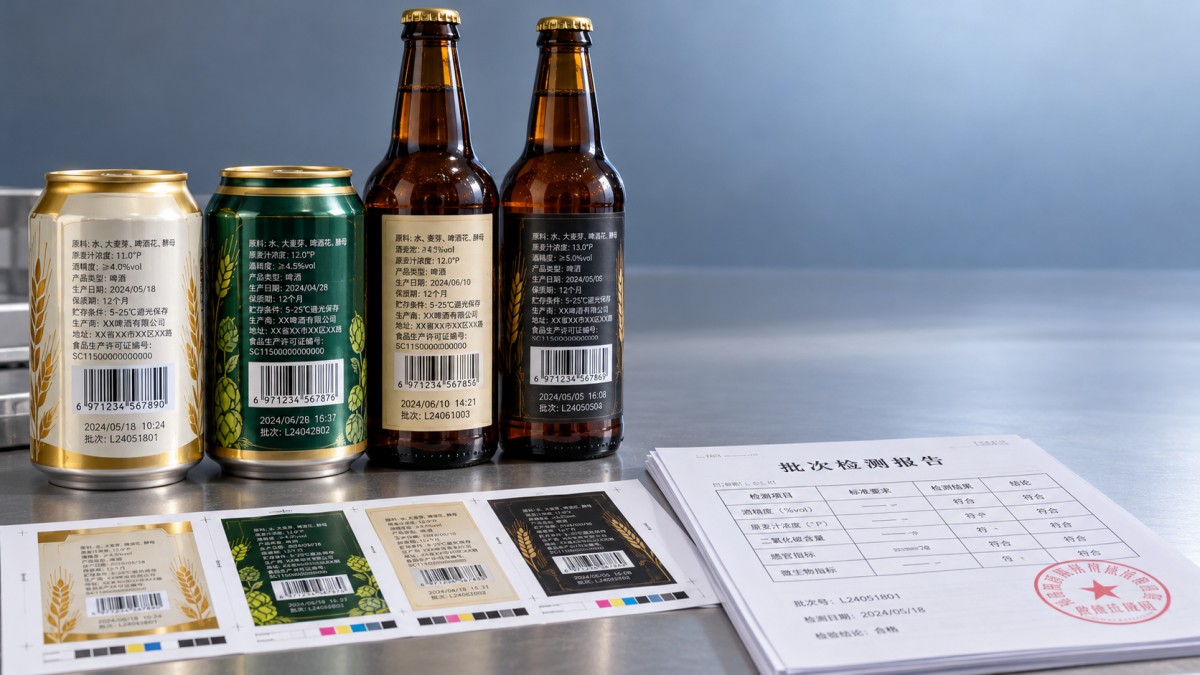
When finalizing the label, also check the can, bottle label, outer carton, and coding plan. Whether the date format is unambiguous, the batch number is traceable, and the importer’s address is complete should take priority over whether the design looks international.
The Key to a Test Report Is Whether It Supports This Shipment
When you receive a report, first check the sample name, specifications, batch, date of testing, and manufacturer. Then review the test items, methods, units, detection limits, and criteria used for assessment. A cropped “pass” conclusion without the full report and sample information makes it difficult to determine whether the report applies to the current order.
Physicochemical, microbiological, contaminant, and other tests should be determined according to product risks, destination-market regulations, and customer contracts. A domestic factory release report should not be treated as a universal export report. Alcohol content labeling must also be checked against the tolerances permitted locally, while indicators related to nutrition claims should be assessed to ensure that the test methods align with local definitions.
A laboratory’s qualifications do not necessarily cover every requirement. Verify that the relevant tests fall within its accredited scope and that the importer accepts the laboratory and methods. If the formula, process, or packaging changes, reassess whether the existing report remains applicable. In particular, a report on a development sample must not be used in place of release criteria for a mass-production batch.
Shelf life should not be promised based on experience alone. Ambient-temperature sea freight, temperature fluctuations, and long-term storage can all affect flavor and stability. Supporting validation documents should be checked against the actual packaging, process, and storage and transportation conditions.
When Comparing Manufacturers, Make Sure Documents Follow the Order
An SC production license, ISO9001, HACCP, and registration as an export food production enterprise can help verify the basics of production and management, but they do not replace destination-market access requirements, product-specific permits, or label review. Also check that certificates are valid and confirm their scope, as well as the relationship between the contracting, production, testing, and exporting entities.
Global Craft Beer Contract Manufacturing Network (ODM.BEER) is affiliated with Shandong Yangchun Beer and can coordinate formula development, packaging design, label compliance review, and filling production. For this type of integrated service, it is worth confirming who maintains formula versions, who consolidates feedback from the importer, who reviews revised labels, and how final documents are approved before mass production—not just whether all the listed services are available.
The Yangchun Beer production base was established in 1987 and has a range of beer formulation processes and packaging production capabilities. When choosing cans, bottles, or kegs, still verify packaging suitability, minimum order requirements, testing timelines, and delivery arrangements for the specific order. Small-batch samples can help validate flavor, but they do not eliminate the need to verify documents for formal export.
Before placing an order, attach the final formula, label version, testing plan, batch traceability requirements, and document checklist to the contract, and clarify responsibility for revisions and reviews. A manufacturer’s ability to provide a complete, consistent, and up-to-date set of documents is more useful for decision-making than a general claim of “export experience.”