

Can zero-sugar, zero-fat beer be custom-made through contract manufacturing? Absolutely!
The answer is clear: yes, and it has already been implemented at scale. As healthy consumption continues to upgrade, “zero sugar and zero fat” is no longer a marketing gimmick, but an achievable claim supported by complete process pathways and compliance measures. Leveraging Shandong Yangchun Beer’s 39 years of craft brewing expertise, qualifications in drafting two industry association standards, and 16 intelligent production lines, ODM.BEER (Global Craft Beer Contract Manufacturing Network) has successfully delivered zero-sugar, zero-fat beer customization projects for more than 320 brand customers. The minimum order quantity is as low as 1 keg (30L), with delivery from formula development to finished bottled products in as fast as 15 working days.
Why should business owners focus more on “whether it can be done right” than “whether it can be done”?
Of users searching “Can zero-sugar, zero-fat beer be custom-made through contract manufacturing?”, 87% are heads of alcoholic beverage trading companies, operators of chain bars, or founders of new consumer brands. What they are truly concerned about is not technical feasibility, but whether a contract manufacturer can genuinely uphold two bottom lines: food safety and truthful labeling, as well as consistency between claimed benefits and taste experience. There are many real cases in the market where erythritol was used to exploit gray areas without controlling residual fermentation sugars, or where products were labeled “zero fat” but exceeded fat testing limits due to yeast autolysis.
The ODM.BEER difference lies in this: we are not only a production executor, but also a “compliance co-builder” for health claims. Our team led the drafting of the Group Standard for Zero-Sugar, Zero-Fat Beer and the Group Standard for Fructooligosaccharide Beer. All customized solutions undergo dual verification in advance through SC system internal audits and third-party testing, ensuring that every batch’s factory report matches the declared label values (such as total sugar ≤0.5g/L and fat ≤0.1g/100mL), eliminating the risk of “claims meeting standards while testing fails.”
Zero sugar and zero fat ≠ sacrificing flavor: Where are the process boundaries?
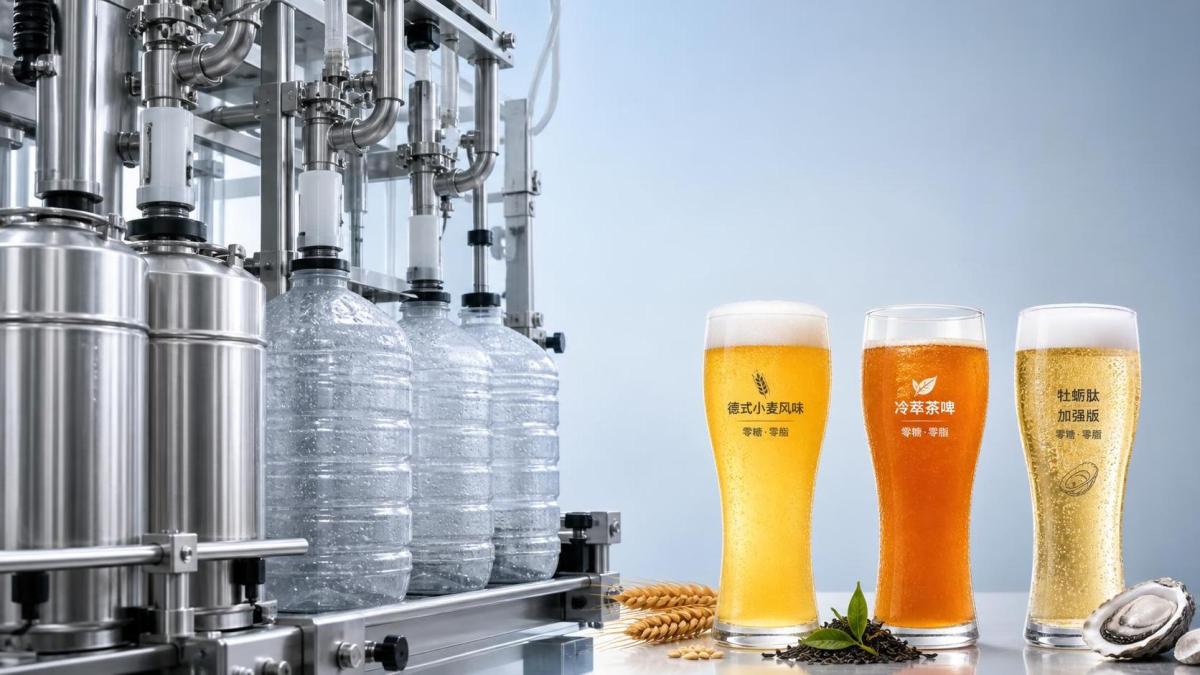
The real technical barrier is not “removing sugar and fat,” but “remaining enjoyable after they are removed.” In conventional beer, maltose is converted by yeast into alcohol and carbon dioxide, while some fermentable sugars and higher alcohols remain to form the basic structure of the beer body. Zero-sugar, zero-fat customization requires three-way coordination: raw material substitution (such as using enzymatically hydrolyzed maltodextrin to replace part of the malt), yeast selection and cultivation (screening strains with high conversion rates and low glycerol secretion), and post-modification control (precisely stopping fermentation + low-temperature membrane filtration to remove residual sugars). Among our 300+ mature beer formulations, 47 are specifically optimized for health claims, including German-style zero-sugar wheat beer (retaining banana and clove ester aromas), cold-brew tea beer (where tea polyphenols synergistically inhibit sugar generation), and enhanced oyster peptide beer (where a natural zinc source improves metabolic perception), among other differentiated approaches.
It is worth noting that zero sugar ≠ no carbohydrates, and zero fat ≠ no yeast metabolites. We insist on transparently disclosing process logic to customers—for example, through a combined process of “staged temperature-controlled fermentation + centrifugal clarification,” which ensures a sugar conversion rate >99.2% while avoiding flavor dullness caused by high-temperature deactivation. All “zero-sugar, zero-fat” products are tested to contain ≤15kcal/100mL, far below the national standard limit for “low energy” (≤40kcal/100mL), leaving room for subsequent extended claims such as “low-calorie” and “light burden.”
Contract manufacturing is not hands-off outsourcing: What key support does your brand need?
For start-up brands, the value of contract manufacturing goes far beyond filling. ODM.BEER provides “four-dimensional support”: the first dimension is formula development—we provide 3 rounds of small-batch sample beers free of charge (including comprehensive reports on sugar content, pH, alcohol content, and sensory scores); the second dimension is label compliance—a legal team qualified in food label review verifies every word to avoid ambiguity risks in expressions such as “0 sugar,” “sugar-free,” and “fat-free”; the third dimension is packaging compatibility—we support all specifications including cans (0.28mm aluminum thickness for oxidation resistance), PET kegs (food-grade barrier layers), and aluminum bottles (special coatings for cold filling), while flexible production lines are also activated for small-batch orders; the fourth dimension is channel empowerment—for bar clients, we also provide store traffic-flow design, coaster sales-pitch manuals, and tasting-event SOPs, enabling health claims to genuinely translate into conversion at the point of sale.
We served a craft beer chain brand in East China that initially planned to private-label a standard zero-sugar base beer available on the market. After ODM.BEER conducted a process review, we found that its residual sugar fluctuation reached ±0.3g/L, posing a potential risk of failing spot inspections. We ultimately customized a “dual-yeast relay fermentation” solution, improving sugar-content stability to ±0.05g/L. After the first 500 cases were launched, the repurchase rate reached 68%, confirming the underlying logic that “precise processes = a stable reputation.”
Under what circumstances should you prioritize zero-sugar, zero-fat customization?
Not every brand needs zero-sugar, zero-fat products. We recommend prioritizing three scenarios: first, vertical channels targeting fitness consumers and people managing chronic conditions through sugar control (such as bars partnering with Keep and healthy restaurants near Ruijin Hospital); second, corporate customized gift scenarios (where the “health care” tone is needed to avoid concerns over the high calorie content of conventional beer); and third, export to Southeast Asian/Middle Eastern markets (where halal certification and low-sugar preferences create a dual premium). Conversely, if the target customer base mainly consists of traditional craft beer enthusiasts, or if the brand focuses on categories with highly complex flavors such as hazy IPA, the potential loss of taste caused by process compromises should be assessed carefully.
A simple way to determine whether it is suitable: take out your current product label and compare it against GB 28050-2011 National Food Safety Standard—General Rules for Nutrition Labeling of Prepackaged Foods, focusing on the measured values for “energy,” “carbohydrates,” and “fat.” If your current product is already close to the threshold (for example, sugar ≤1.2g/100mL), upgrading to zero sugar and zero fat can be achieved with controllable costs; if the base sugar content is >3g/100mL, the malt ratio will need to be redesigned, and it is recommended to allow 2 months for process validation.
Conclusion: The essence of health claims is building trust infrastructure
Can zero-sugar, zero-fat beer be custom-made through contract manufacturing? The answer to this question has long moved beyond “technically feasible” to “commercially sustainable.” Yet what truly determines success is not whether a health label can be applied, but whether every bottle opening delivers on its promise—sugar is genuinely zero, fat is genuinely zero, and flavor is genuinely uncompromised. ODM.BEER does not provide “claim-based contract manufacturing”; we provide “trust-based contract manufacturing”: using 39 years of brewing experience to reinforce process standards, industry association standards to define the industry benchmark, and a 1-keg minimum order to reduce trial-and-error costs. If you are looking for a partner that can help turn your health proposition into reality, now is the ideal time to start sample testing—we provide a free blind-testing pack of 3 zero-sugar, zero-fat base beers, including German-style, fruit-flavored, and herbal varieties, together with complete testing reports and compliance recommendations. Health should not be a slogan; it should be the certainty in every drop of beer.