

The information about the commissioning party and manufacturer on a contract-brewed beer label must first be assessed against the labeling rules applicable to the product. Under the National Food Safety Standard General Rules for the Labeling of Prepackaged Foods (GB 7718—2011), prepackaged foods processed under contract may display the names and addresses of both the commissioning party and the commissioned processor, or only the commissioning party’s name and address together with the place of origin. The place of origin must be stated at least to the prefecture-level city. Both options are subject to conditions; this does not mean that simply printing the brand company’s name is sufficient.
For beer brands planning to use packaging over the long term, a safer approach is to list the commissioning party and the commissioned manufacturer separately and verify the actual production factory, production address, and food production license number. GB 7718—2025 and the Measures for the Supervision and Administration of Food Labeling will take effect on March 16, 2027, and the requirements for information about contract manufacturing have been adjusted. Packaging design and inventory planning should account for the transition between rules as part of the review.
First distinguish the commissioning party from the actual manufacturer
The brand owner, trademark licensor, distributor, and commissioning party may be the same company or separate entities. The roles stated on the label must reflect the actual business relationship. Do not automatically identify the trademark registrant as the “commissioning party,” or use the payee or sales company in place of the enterprise responsible for production.
Before review, check the contract manufacturing agreement, the business licenses of both parties, and the commissioned party’s food production license and product-category details together. Use the full name of the relevant legal entity for the commissioning party; identify the commissioned party as the licensed enterprise actually undertaking production. A group name, abbreviated brand name, or promotional name for a factory site cannot automatically substitute for the legal entity’s name.
This is particularly important when multiple breweries supply the same brand or when one company has multiple production sites. The specific licensed production address where the batch will be produced must be clearly identified. Do not use another factory’s name and SC number merely because it belongs to the same group.
The two labeling options have different review priorities
When reviewing a label under GB 7718—2011, the following two formats can help distinguish the information relationships. Replace the fields shown with actual information; these examples are not complete labels for direct use.
- Listing both parties: Commissioning party: Company A; address: the corresponding address of Company A. Commissioned manufacturer: Company B; address: the corresponding address of Company B.
- Listing only the commissioning party: Commissioning party: Company A; address: the corresponding address of Company A; place of origin: the actual production location, stated at least to the prefecture-level city.
The first option makes the production relationship easier for purchasers, distribution channels, and consumers to identify. Under the second option, “place of origin” is mandatory and must correspond to the actual production location. For example, if the commissioning party is in Shanghai and the beer is produced in a city in Shandong, Shanghai cannot simply be stated as the place of origin. The commissioning party’s address and the product’s place of origin serve different informational purposes and cannot replace one another.
These are only options for stating information about the parties to contract manufacturing; they do not mean that the rest of the label is complete. Contact information, the food production license number, and other applicable mandatory labeling items must still be reviewed separately. A customer-service QR code, brand WeChat account, or distributor’s phone number cannot be assumed to replace contact information required by law.
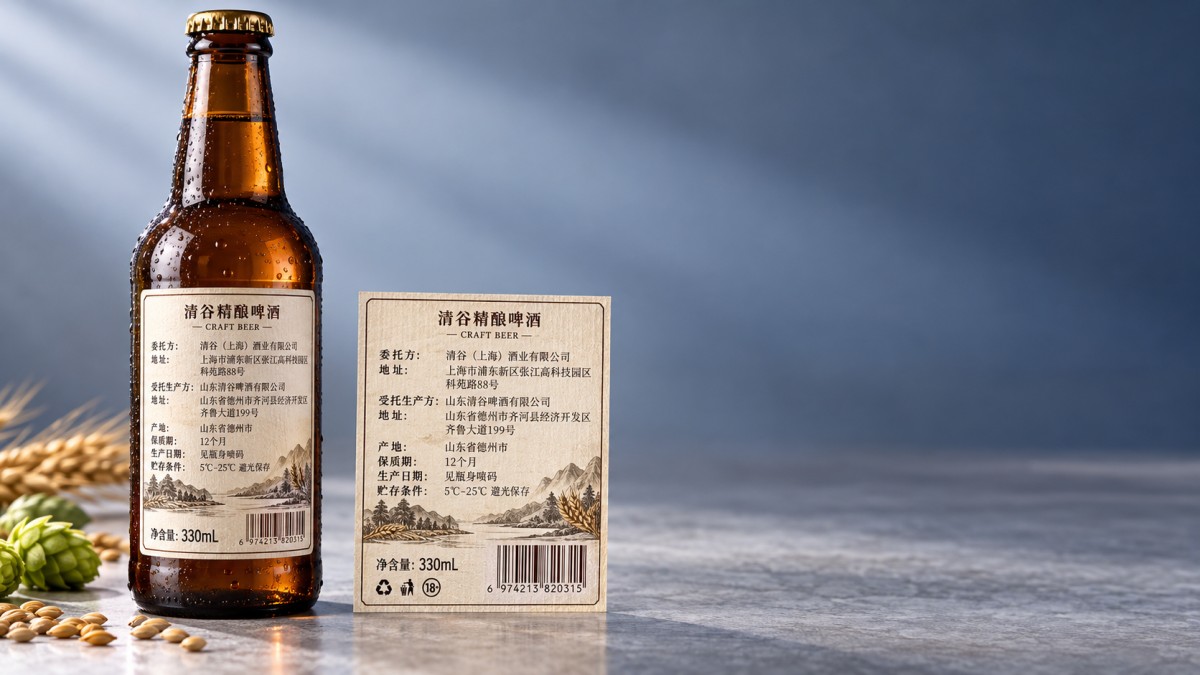
Packaging intended for use across the effective date of the new rules should also be checked separately against the new requirements. Once GB 7718—2025 and the accompanying Measures for the Supervision and Administration of Food Labeling take effect, foods produced under contract must identify the commissioning party and commissioned party in accordance with the new requirements. The simplified option under the previous standard should not continue to be treated as a generally applicable long-term solution. When arranging printing, determine which version applies based on the production date, packaging usage period, and transition provisions.
The SC number, address, and place of origin must point to the same production chain
Beer produced under contract must display the food production license number applicable to the commissioned manufacturing enterprise. The brand company’s business license, trademark registration certificate, or the production license of another company in the group cannot substitute for the license information of the actual manufacturer.
When checking the SC number, do not just confirm that the number exists. Verify that the license is valid, that its scope covers the product to be manufactured, and that the actual production address falls within the licensed scope. For products with differentiated formulations, first determine the product category; do not assume that all innovative alcoholic beverages should be treated as beer.
Addresses also need to be distinguished by purpose. The registered address on a business license, the production address on a license, a warehouse address, and a brand office address may differ. The relevant label fields must meet the applicable rules and correspond to supporting documents. Where the registered address and production address differ in circumstances covered by law, follow the applicable provisions; do not choose an address simply because it is convenient for the layout.
Promotional claims such as “country of origin” or “brand originating from” should be reviewed separately. Using imported malt or foreign hops, or following a particular country’s recipe style, does not change the product’s actual place of manufacture and cannot justify stating a foreign place name as the place of origin for beer contract-manufactured in China.
Turn entity information into a traceable review record when approving the proof
Quality-control review should not stop at checking whether “the text looks complete.” A label ready for approval should be traceable through each link: “contractual relationship—actual factory—license information—packaging version—production batch.” Complete at least these three checks before printing:
- Verify the parties: The names on the label match the contract and certificates, and the roles of the commissioning party, commissioned manufacturer, distributor, and other parties are clearly stated.
- Verify the factory: The production entity, address, place of origin, and SC number on the label match the factory scheduled to receive the production order.
- Verify the version: Confirm the applicable standard, planned production date, and packaging scope of use, and retain the approved proof, review basis, and approval records.
Shared packaging is especially prone to mismatches. If multiple factories use the same can or bottle label, address identification of the actual manufacturer and completeness of the information at the design stage. Simply listing all factory names side by side does not complete the review. A change of factory, company name, address, or license information should trigger a label re-review.
Packaging that has already been printed is not a reason to continue using incorrect information. If an issue is found, first isolate the affected packaging and batches, then determine whether rework or correction is appropriate. Any corrective measure, such as an additional label, must also meet the applicable requirements for truthfulness, clarity, and secure attachment. The parties may agree in their contract on who designs and reviews the label and who bears the costs, but this does not exempt either party from its respective legal responsibilities.
For the next batch of contract-brewed beer, the most valuable step is to review the proposed label together with the actual production order. Only when the parties, factory, and batch are matched do the names of the two companies on the label have a verifiable business meaning.