

Export compliance qualifications are a fundamental threshold for craft beer contract manufacturing partnerships
Whether export compliance qualifications are in place directly determines whether a customized beer can legally enter its target market. Relying on the physical brewing base of Shandong Yangchun Beer, Global Craft Beer ODM Network (ODM.BEER) has obtained China’s Food Production License (SC), ISO 9001 Quality Management System Certification, HACCP Food Safety System Certification, and customs registration qualifications for food production enterprises exporting food. These four qualifications form the basic compliance framework for export contract manufacturing: SC is a prerequisite for domestic production access; ISO 9001 covers quality control checkpoints throughout the entire process; HACCP establishes monitoring limits for critical hazard points in beer, including microorganisms, alcohol-content fluctuations, and heavy-metal migration; and export food registration indicates that the enterprise has passed on-site customs inspections and is capable of supplying food products overseas. All four are indispensable. An SC certificate alone cannot meet overseas customs clearance requirements, while ISO or HACCP certification alone does not signify export eligibility.
Label compliance is not simply a matter of “applying a label,” but an engineering process of adapting to regulations in multiple countries
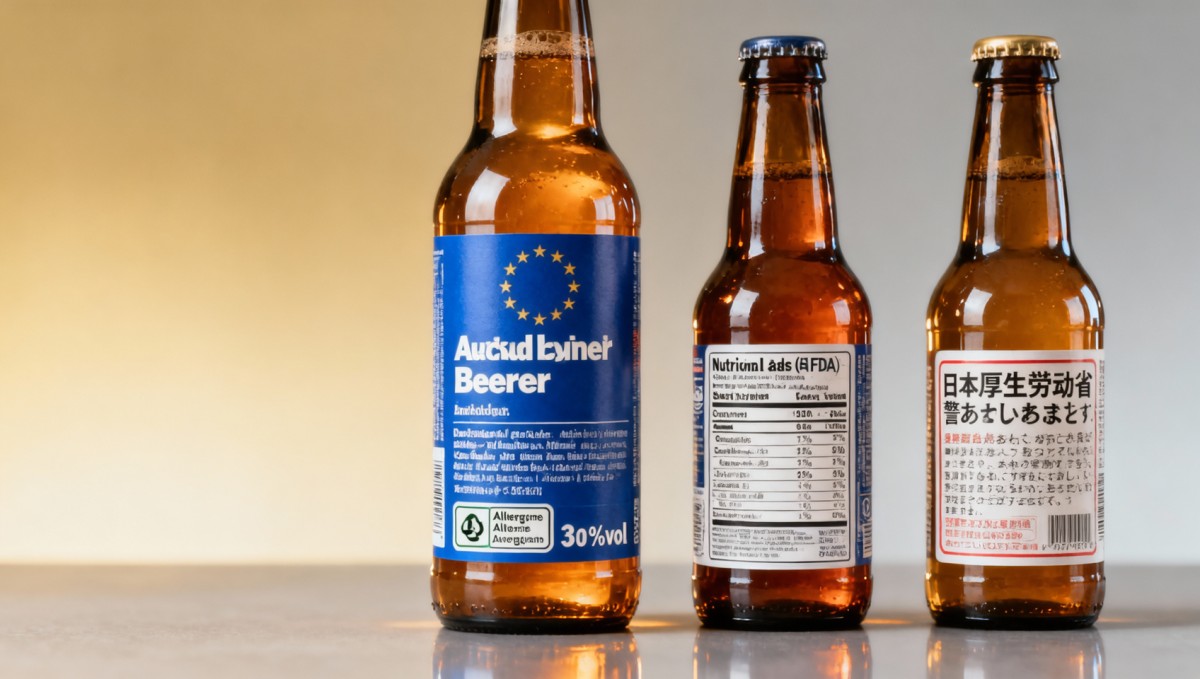
When contract-manufactured beer is exported, label content must simultaneously meet the regulatory requirements of the country of origin and the mandatory requirements of the importing country. Taking the European Union as an example, labels must state alcohol content (% vol), net content, country of origin, allergen information (such as barley and wheat ingredients), shelf life (not “best drinking period”), manufacturer address, and batch number. The U.S. FDA requires a Nutrition Facts panel (including calories, carbohydrates, protein, etc.), and the font height must not be less than 1/16 inch. Japan’s Ministry of Health, Labour and Welfare requires alcohol content to be accurate to one decimal place and mandates a Japanese warning stating, “This product contains alcohol. Consumption by minors is prohibited.” The same German wheat beer may be labeled “Hefeweizen” in Germany, but in Canada it must carry both English and French product names. ODM.BEER’s label compliance review does not simply apply templates; rather, it verifies text, symbols, placement, font size, language hierarchy, and printing durability item by item according to the latest regulations of the target country (such as EU No 1169/2011 and U.S. 21 CFR Part 101). For example, laser coding on aluminum bottles must remain legible after transport abrasion, while thermal-transfer labels on PET kegs must pass temperature-change testing from -20℃ to 45℃ without peeling off.
Certification confirmation must distinguish between “basic qualifications” and “product-specific certifications”
Before cooperation, two types of certification must be clarified: one is factory-level general qualifications (such as SC and HACCP), and the other is additional certification for specific products or processes. For example, hyaluronic acid beer requires import registration certificates for hyaluronic acid raw materials and proof of compliance for the addition level (China’s GB 2760-2024 permits its use as a food additive, but limits vary by country). Oyster peptide beer involves animal-derived ingredients; the EU requires slaughterhouse hygiene certificates and a pathogen-free validation report for the peptide extraction process. If fructooligosaccharide beer claims a “prebiotic function,” it must comply with FSANZ standards in Australia and be supported by clinical efficacy documentation. These certifications do not automatically take effect with factory qualifications. Documentation lists must be submitted at the order initiation stage, and ODM.BEER’s quality control team works with third-party testing organizations (such as SGS and Intertek) to complete preliminary reviews. Failure to confirm in advance may result in an entire shipment being detained for reinspection at the destination port, incurring demurrage charges and label rework costs.
The sample application process is essentially a compliance rehearsal
Free beer sample tasting is not only a taste-confirmation step, but also the first practical test of the export compliance chain. When submitting a sample application, customers must also provide the target market, intended packaging format (such as whether aluminum bottles have a pull-ring structure), expected filling volume, and a preliminary label draft. Based on this information, ODM.BEER prepares three documents: first, a Sample Compliance Pre-Review Form, listing differences between the country’s current regulatory provisions and the current label draft; second, a Physicochemical Index Comparison Sheet, comparing the customer’s required alcohol content (such as 5.2%vol) with the actual fermentation control accuracy (±0.1%vol); and third, a Packaging Compatibility Statement, specifying whether the inner coating of tinplate kegs complies with the food-contact material migration limits under EU Directive 2004/27/EC. Before samples are dispatched, customs HS code pre-classification has been completed (for example, beer is classified under 2203.00), preventing rejected declarations caused by classification errors during subsequent bulk customs clearance. This process enables customers to understand actual compliance risk points before placing formal orders, rather than relying on verbal commitments.
Flexible boundaries within the scope of ODM services
Contract manufacturing capabilities cover everything from small-batch trial production starting from one keg to mass production at the scale of tens of thousands of tonnes, but compliance adaptation has process boundaries. For example, if fruit craft beer uses a fresh-fruit cold extraction process, an additional BRC certification review of the juice supplier is required. When canned beer is transported in high-temperature, high-humidity areas, a nitrogen pressurization can-sealing process must be used to inhibit oxidation, and this parameter must be included in the appendix to the Technical Agreement signed by both parties. ODM.BEER does not provide all-inclusive compliance coverage. Instead, it divides certification responsibilities by stage: the factory is responsible for production qualifications and the basic label framework, while the customer is responsible for providing the latest regulations of the importing country and the basis for special claims (for example, a “zero sugar” claim requires a third-party test report). Both parties jointly confirm the final label proof. This division of responsibilities prevents compliance failures caused by delayed information from either party and is also consistent with the clear allocation of principal responsibilities under regulations in various countries.