

Having a beer produced by a contract brewery and obtaining a food production license do not, by themselves, mean that the qualification review is complete. For quality control and food safety personnel, the key questions are: Who is the license issued to? Is it valid? Which address is approved for production? And does the beer to be commissioned fall within the scope listed on the license? This is especially important for fruit-flavored beers and innovative beers containing distinctive ingredients, whose category cannot be determined by product name alone.
This review should ideally take place before the formula is finalized, packaging is printed, and the contract is signed. The taste of beer samples can be adjusted repeatedly, but a mismatch between the licensed scope and the product attributes may affect production arrangements, labeling, and the launch schedule.
Do not request only the front page of the license—verify the production entity
Request the brewery’s current and valid original and duplicate food production license, along with the detailed list of food categories and varieties covered by the license. For electronic licenses, verify their source and status as well. Also obtain the business license and compare the company name, Unified Social Credit Code, registered address, and production address item by item.
The contract signatory, service contact, and actual producer may not be the same entity. This does not necessarily indicate a problem with the cooperation, but it must be clear who will actually brew and fill the beer, which producer will be named on the finished product label, and which entity will assume the corresponding responsibilities. A license belonging to a group company, an affiliated company, or another production site cannot replace the license of the factory actually producing the beer.
- Check the name: If the company has changed its name, have the business license and production license information been updated accordingly?
- Check the address: The registered address is not necessarily the production address. The facility handling the order must be covered by the license.
- Check the validity period: A license is generally valid for five years. Check that it is valid on the review date and whether it is due to expire during the planned production period.
- Check the status: Do not rely solely on the date shown on a scanned copy. Also verify whether the license has been canceled, revoked, or withdrawn, or is otherwise affected in a way that could invalidate it.
If the factory is applying for renewal or a change, do not approve it based solely on a verbal statement that “the application has already been submitted.” Assess the application status, official documentation, and applicable requirements, and include any unresolved items on the pre-production confirmation checklist.
“Alcoholic beverages” is only the starting point: breweries must also verify the licensed product details
Food production license numbers start with “SC,” but the number does not fully describe the scope of products covered. Under the food production licensing classification catalogue, beer falls under “alcoholic beverages,” category number 1503. The licensed product details generally specify types such as pasteurized beer, draft beer, fresh beer, and specialty beer. During the review, refer to the factory’s actual approved product details and the current catalogue.
In other words, a business license that lists “alcoholic beverage production” in its scope of business, or a food category on the production license that says “alcoholic beverages,” does not by itself prove that the factory can produce the beer being commissioned.
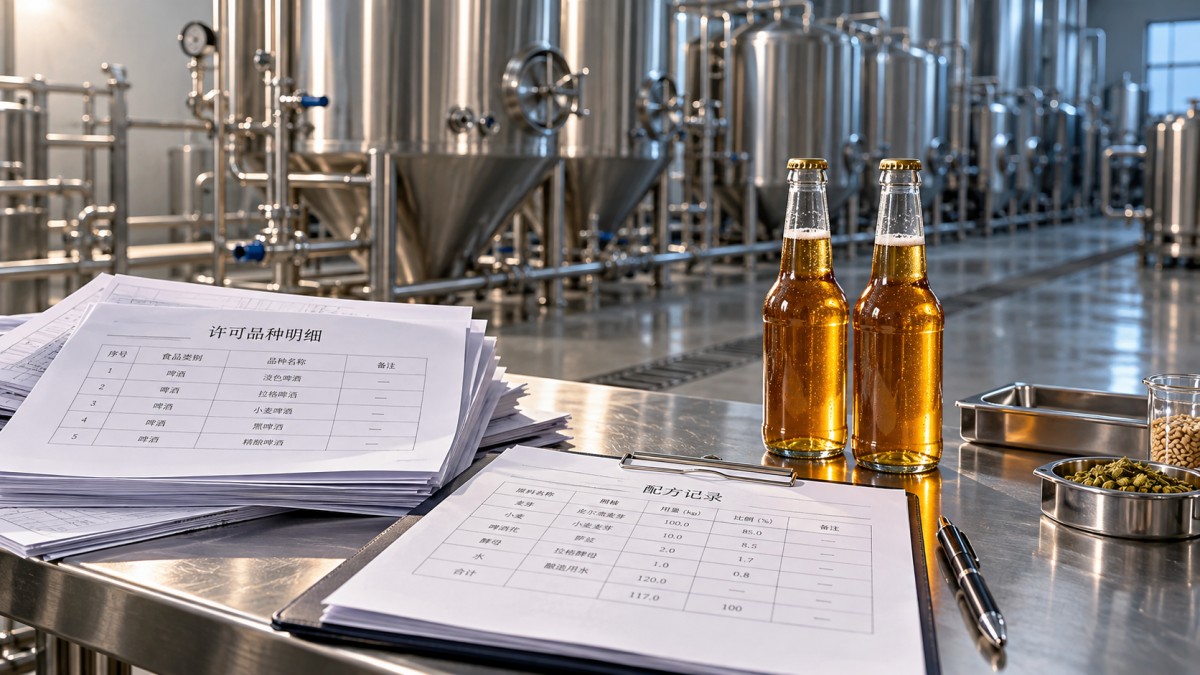
Innovative formulas are most likely to hit a snag when “the name sounds like beer, but the classification may be different”
“Fruit-flavored craft beer,” “hyaluronic acid beer,” and “oyster peptide beer” may be product concepts, but they do not determine the licensing classification. Assessment should be based on the complete formula, the regulatory basis for using each ingredient, the production process, and the applicable product standard—not on a sales name or promotional wording on the front of the packaging.
For ingredients with specific permitted uses, such as sodium hyaluronate, check the relevant announcements and applicable food categories item by item. Do not interpret “approved for use in certain ordinary foods” as “may be added to all beer.” For ingredients such as oyster peptides, also verify their status as food ingredients, quality requirements, and applicable regulatory basis. Food additives must be checked against the permitted uses and limits in current national food safety standards.
The licensed scope, ingredient legality, and product standard are three separate review checkpoints. A factory’s license for specialty beer does not mean that it can produce any formula containing distinctive ingredients. Nor can the use of an enterprise standard or group standard expand the scope of the production license. For products with unclear regulatory boundaries, consult the local licensing authority before production and retain the supporting documentation.
Build an evidence trail through record checks, on-site reviews, and documentation
After obtaining the licenses, cross-check them using the food production licensing information channels made available by the issuing authority or the provincial market regulation department, and record the date, source, and results of the search. The National Enterprise Credit Information Publicity System can help verify company registration and administrative penalties, but it cannot replace a review of the detailed food production license. If public information is incomplete or has not been updated consistently, contact the issuing authority for confirmation.
An on-site review should answer another question: Is the licensed scope on the document actually reflected on the production line handling this order? Focus on whether the brewing, fermentation, filtration, pasteurization, and filling processes match the declared process, and check records for cleaning and disinfection, batch traceability, finished-product testing, and retained samples. Packaging format alone cannot determine the licensing category, but when switching between bottles, cans, or kegs, assess whether the equipment and process are suitable.
For each product to be commissioned, consider preparing a one-page verification record linking at least the license and its detailed product list, official search results, actual production address, formula version, process flow, applicable standard, and label artwork. If discrepancies are found, assign responsibility for corrections and set a re-review point; do not simply leave “to be provided later” in chat records.
Include qualification checks in the contract brewing workflow
When working with platforms such as Global Craft Beer Contract Manufacturing Network (ODM.BEER), which offer formula development, packaging design, and filling services, quality control teams can raise qualification requirements from the sampling stage. If production is arranged across different locations, such as Shandong, Qinghai, or Hainan, verify each factory that will actually handle production. ISO9001, HACCP, and registration as an export food production enterprise may be used as supporting materials for assessing relevant capabilities, but they do not replace a food production license.
The contract should also specify a notification and re-review mechanism if the production site, formula, or process changes. For the commissioning party, a reliable basis for release is not “the factory says it can do it,” but that the production entity can be verified, the license covers the product, the formula has a valid basis, and production is traceable—with each conclusion applying to the order in question.