What is the scope of Shandong Yangchun Beer's ODM services? What product categories and processes can food-grade craft beer contract manufacturing cover?
Sep 09, 2026
Have you encountered situations like these too?
You want to create your own craft beer, but get stuck at the very first step—unable to find a contract manufacturer that truly understands your vision?
You want to try hyaluronic acid wheat beer, oyster peptide IPA, or zero-sugar mango cider, but when you ask for a quote, the other party cannot even explain the basic process parameters;
Or perhaps, after finally agreeing on the formula and packaging, you discover during filling that the label is non-compliant, can indentations are inconsistent, and batch flavors are unstable...
This is not your fault. These are the real pitfalls many beverage brands, chain pub operators, and corporate gift planners have encountered when launching their own beer projects.
What does Shandong Yangchun Beer’s ODM service cover? Behind this question are more practical needs:
**“Can you really make the beer I want?”**
**“Can I make samples first for small-batch trial production? What if it does not sell—will inventory be left over?”**
**“For export versions, do you have the required filing qualifications and overseas compliance experience?”**
We will not beat around the bush—Yangchun Beer’s ODM service is not an assembly line of “order taking—production—shipment,” but a **tangible, verifiable, and scalable customized support system**.
First is the breadth and depth of beer formulation technology.
More than 300 proven specialty beer formulation processes are not simply a list of flavor names. Each has undergone at least three rounds of laboratory small-scale trials, two rounds of pilot validation, and one production-scale stability review. For example, for German wheat beer, we offer not only the classic Bavarian recipe, but can also adjust yeast pitching rate, lactic acid bacteria proportion, and haze-control logic according to customer requirements, achieving precise control from “refreshing with slight tartness” to a “dense, cloud-like mouthfeel.” Fruit craft beers cover three technical approaches: cold-extracted juice addition, secondary-fermentation infusion, and low-temperature fruit-peel extraction, avoiding an artificial-flavor impression while retaining the freshness of real fruit. Then there are the increasingly popular “functional craft beers”: hyaluronic acid beer has undergone human metabolic tracking tests to verify its active ingredient retention rate within 72 hours under a 4°C cold chain; the oyster peptide version uses a dual process of ultrasonic cell-wall disruption and low-temperature enzymatic hydrolysis to ensure that marine protein components are stably incorporated into the wort base, rather than serving as a superficial “conceptual addition.”
Second is end-to-end adaptability across packaging formats.
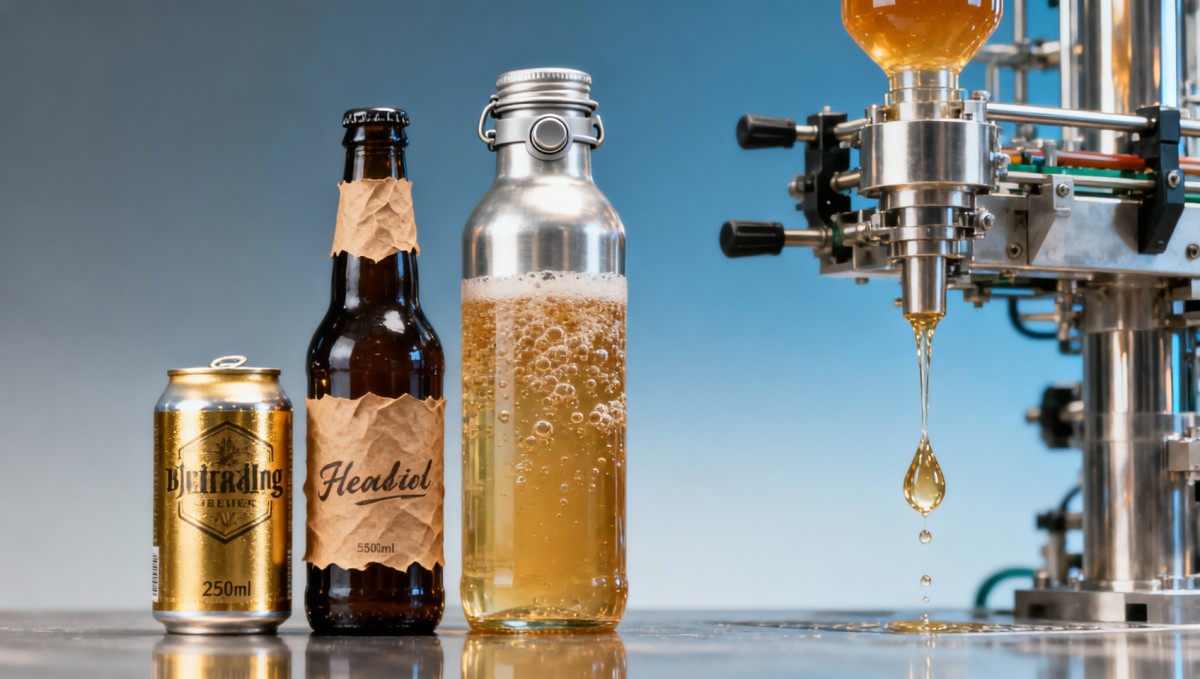
Cans, glass bottles, aluminum bottles, tinplate kegs, and PET kegs—these are more than container options; they are extensions of channel strategy. For fast-moving convenience-store sales, 250 ml cans with UV hot-stamped labels are preferred; premium pubs favor 500 ml dark glass bottles with handmade paper labels; corporate gift boxes tend toward 750 ml aluminum bottles with magnetic-opening designs; while outdoor camping scenarios require 1 L PET kegs with leak-proof locking structures. Yangchun’s 16 fully automated intelligent filling lines can switch between mixed order runs without a mold-modification cycle. More importantly, all packaging materials are supplied directly by SC-certified suppliers, and a compliance-check module is automatically embedded before label printing, covering such items as alcohol-content label placement, warning-text font size, and traceability codes for imported raw materials, thereby avoiding regulatory inspection risks at the source.
Third is the confidence to provide flexible delivery.
“A minimum order of one keg” is not a marketing slogan. It is built on Yangchun’s self-developed intelligent warehousing and logistics system—its bases in Shandong, Qinghai, and Hainan work together to automatically allocate the optimal production site based on the customer’s delivery location. For example, when an East China customer orders fruit-purée hazy IPA, the system prioritizes the cold-storage fermentation tanks at the Qingdao plant; for Southeast Asian export orders shipped by sea, the Hainan base is activated nearby to complete filling, fumigation, and inspection in a one-stop outbound process. Small-batch orders also receive a full range of R&D support: three basic beer samples free of charge, one packaging proofing service, and one preliminary label-compliance review report. Many customers relied on this keg of trial-brewed beer to obtain their first feedback from end users before confidently placing additional mass-production orders.
Finally, and most easily overlooked, is long-term brand empowerment.
ODM should not stop at “making the beer”; it should help customers “establish the brand.” The Yangchun team participates in early-stage positioning discussions: Who is this beer for? Is it intended to attract traffic to a bar, or to reinforce cultural identity as a corporate gift? In different scenarios, alcohol content, IBU bitterness, residual sugar, and even foam retention on the glass all need to be recalibrated. We once assisted a Chinese-style tea beverage brand in developing “Osmanthus Oolong Wheat Beer.” In addition to adjusting the hop combination to complement the tea aroma, we simultaneously designed a biodegradable bamboo-pulp bottle label and a tactile Braille logo, ultimately making it a standard check-in item at its offline stores. This depth of collaboration comes from 39 years of experience in the craft beer industry—not making decisions for customers, but ensuring that every decision is supported by data, backed by process expertise, and validated by market response. Of course, trust is never built on a list of qualifications alone. ISO9001, HACCP, and export food filing are mandatory entry requirements; leading the drafting of the two industry association standards, *Zero-Sugar, Zero-Fat Beer* and *Fructooligosaccharide Beer*, is a response to genuine industry pain points. Having served more than 1,000 brands, we have developed an adaptive rhythm through countless formula iterations, label reworks, and emergency logistics responses.
If you are at the starting point of your own beer project, you may first ask yourself:
- What is the one sip you most want people to remember about this beer?
- In what setting, and by whom, will it be opened, shared, and repurchased?
- Do you expect a partner that is merely a “workshop” responsible for execution, or a “brewing partner” willing to refine every detail with you?
What does Shandong Yangchun Beer’s ODM service cover? The answer is not in a list, but in every real journey from a sample cup to a retail shelf.
We do not undertake contract manufacturing that is “good enough”; we only accept commissions “worth considering time and again.”
Now, that keg of beer that belongs to you is already quietly bubbling in the fermentation tank.
Of course, trust is never built on a list of qualifications alone. ISO9001, HACCP, and export food filing are mandatory entry requirements; leading the drafting of the two industry association standards, *Zero-Sugar, Zero-Fat Beer* and *Fructooligosaccharide Beer*, is a response to genuine industry pain points. Having served more than 1,000 brands, we have developed an adaptive rhythm through countless formula iterations, label reworks, and emergency logistics responses.
If you are at the starting point of your own beer project, you may first ask yourself:
- What is the one sip you most want people to remember about this beer?
- In what setting, and by whom, will it be opened, shared, and repurchased?
- Do you expect a partner that is merely a “workshop” responsible for execution, or a “brewing partner” willing to refine every detail with you?
What does Shandong Yangchun Beer’s ODM service cover? The answer is not in a list, but in every real journey from a sample cup to a retail shelf.
We do not undertake contract manufacturing that is “good enough”; we only accept commissions “worth considering time and again.”
Now, that keg of beer that belongs to you is already quietly bubbling in the fermentation tank.