

What Is the Safest First Step When Creating Your Own Beer Brand?
Many beverage trading companies, chain restaurant owners, and decision-makers looking to use custom beer as corporate gifts often get stuck on one question when deciding to create a private-label beer: Should they determine the flavor first or design the packaging first?
If this order is reversed, it can easily lead to repeated revisions, increased costs, or even poor sales after the product launches. The truly logical process should work backward from the core question of “who you want to sell to and in what setting,” and then determine the beer, packaging, and specifications.
A mature ODM manufacturing service is essentially designed to help you complete this reverse-planning process, from formula development to packaging customization, with every stage implemented around the final sales objective.
Step One: Define the Beer Direction First—Do Not Rush to Finalize the Formula
Before contacting an OEM manufacturer, many people have already decided to make products such as “osmanthus wheat beer” or “passion fruit gose,” believing that a distinctive flavor is enough. In practice, however, the biggest pitfall at this stage is: focusing too heavily on unusual flavors while overlooking their acceptance among a broad consumer base.
If your product is intended for supermarkets or offline distribution channels, established styles such as German-style wheat beer and basic fruit-flavored craft beer generally have much higher repurchase rates than “novelty flavors.” Conversely, if your target channels are boutique bars, nightlife venues targeting younger consumers, or differentiated gift products, innovative concepts such as hyaluronic acid beer and oyster peptide beer offer clear advantages in generating attention.
Therefore, the criteria for selecting a beer are simple: first consider your sales channels and target consumers, then choose the corresponding flavor profile. Yangchun Beer has more than 300 mature beer formulations in reserve. At this stage, you do not need to develop a product from scratch; instead, you can identify the most suitable option from existing proven solutions and then make minor adjustments according to your needs. This both shortens the development cycle and reduces the risk of entering the market for the first time.
Small-Batch Trial and Error Is Equally Important
Even after you have selected the beer direction, it is advisable to first validate the market with a small-batch order. Many business decision-makers overlook this point—they order dozens of tons at once, only to receive poor feedback after distribution, resulting in immediate inventory pressure. A mature ODM provider will support flexible production starting from just one keg. Manufacturers such as Yangchun Beer can first produce small-batch samples for you, allowing customers to taste them and provide feedback. Once everything is confirmed, you can scale up production. This is the most reliable approach.
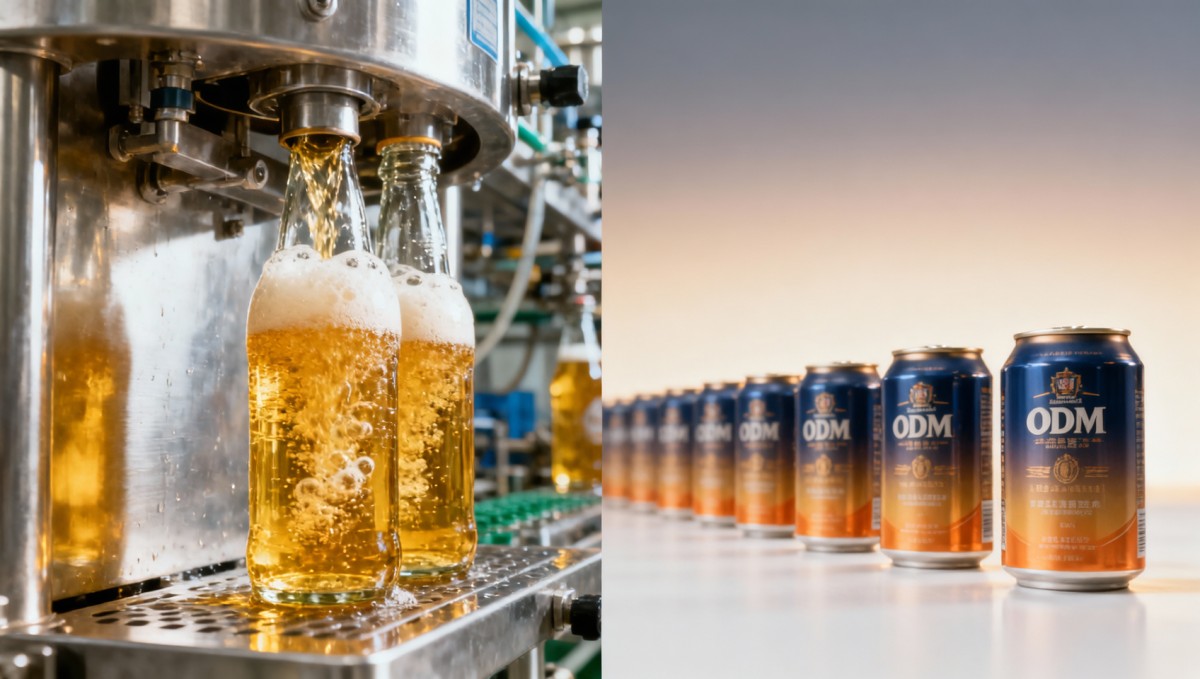
Step Two: Packaging Design Must Serve the Channel and Cost Requirements
Packaging is often the area where business owners invest the most thought, but one detail is frequently overlooked: whether packaging looks good in design is different from whether it can run smoothly on the production line and pass label compliance review.
For example, you may design an attractive custom-shaped bottle or special aluminum bottle, but if the filling speed or labeling method does not match the production line, either capacity cannot be increased or the bottle cap seal may fail. Ultimately, this affects product quality and delivery timelines. More practically, if certain promotional wording on the label does not comply with regulations, the entire batch may be required to undergo rectification.
This is where the value of a professional ODM provider becomes evident—they not only offer original packaging design but also assist with label compliance review at the same time. Yangchun Beer has comprehensive SC production qualifications and export food registration in this area, meaning it understands labeling requirements in both domestic and overseas markets and can help you avoid subsequent regulatory risks during the design stage.
How Should Packaging Specifications Be Determined?
Everyone is familiar with standard cans and glass bottles, but if you are targeting corporate gifts or premium bar channels, packaging such as tinplate kegs and aluminum bottles can create a more premium image and make it easier to achieve a price premium. PET kegs, meanwhile, are suitable for fresh craft beer with a short shelf life and cold-chain delivery, mainly for direct supply to bars and restaurant back-of-house operations.
When choosing packaging specifications, you can refer to a simple guideline: for high-volume supermarket channels, 330ml or 500ml cans are mainstream; for social and gift occasions, aluminum bottles or tinplate kegs may be considered; for foodservice draught beer channels, PET kegs are more suitable. Yangchun Beer covers all these packaging formats and supports flexible combinations of different specifications within the same batch, which is highly practical for brands launching multiple product lines.
Step Three: During Production, Qualifications and Capacity Are Hidden Thresholds
Many business decision-makers assume that finding an OEM manufacturer simply means “giving them the formula and asking them to fill the beer.” However, the issues most likely to arise in actual production are precisely the invisible aspects: quality-control standards and delivery consistency.
For example, does the taste of the same beer vary significantly from batch to batch? Is oxygen content properly controlled during filling? These factors directly determine whether your brand will face negative market feedback after launch. The simplest way to assess whether an OEM manufacturer is reliable is to check whether it has complete production qualifications, such as an SC production license, the ISO9001 quality management system, the HACCP food safety management system, and export food registration (if you plan to engage in foreign trade in the future).
As a physical factory with 39 years of brewing history, Yangchun Beer holds essentially all of these qualifications and led the drafting of two industry association standards: zero-sugar, zero-fat beer and fructooligosaccharide beer. This means its quality-control standards are not self-defined but are recognized industry reference standards, providing OEM clients with more reliable food safety assurance.
The Impact of Production Capacity Layout on Delivery Speed
If you sell only within one province, the location of the OEM facility may have limited impact. However, if you serve the national market or have overseas customers, production location directly affects logistics costs and delivery lead times. Yangchun Beer has production bases in Shandong, Qinghai, and Hainan, enabling nearby shipment and substantial savings in bulk logistics costs. For clients considering overseas trade, the combination of export qualifications and coordinated production locations can deliver significantly higher overall fulfillment efficiency than a single-site factory.
Step Four: Do Not Overlook “Ongoing Operational Support”
Creating a private-label product is only the first step; how to sell it is what truly troubles many business decision-makers. Some ODM manufacturers are responsible only for production and provide no further support after delivery. Mature ODM providers, however, offer channel operation support in addition to basic contract manufacturing, such as helping you clarify product selling points, providing tasting scripts, and even assisting in connecting you with certain channel resources.
This is particularly important for clients trying to establish their own beer brand for the first time. You may not need to build a complete marketing team yourself, as an OEM manufacturer's operational support program can help you save substantial trial-and-error costs. Yangchun Beer provides services ranging from brand incubation to channel operations in this regard. This is experience accumulated through serving more than 1,000 beverage brands, rather than merely operating as a “production workshop.”
Final Recommendations for Business Decision-Makers
If you are considering launching a private-label beer, do not rush to hire a designer to create the packaging, and do not rely on non-professional assumptions to determine the beer formula. The most logical sequence should be:
- First, clarify your sales channels and target consumers;
- Select the 1–2 most suitable options from existing mature beer solutions and apply for tasting samples;
- After tasting confirmation, proceed simultaneously with packaging design and label compliance review;
- Start with a small batch beginning with one keg for market validation, then decide whether to scale up production.
Following this process will minimize pitfalls and keep capital commitment as manageable as possible. An ODM provider that can simultaneously offer formula development, packaging design, compliance review, and flexible production can save you considerable communication costs otherwise spent coordinating with different suppliers. Yangchun Beer's Global Craft Brewing Contract Manufacturing Network (ODM.BEER) provides a full-process service designed around this logic. In the early stage, you can directly apply for beer tasting samples to first confirm whether the beer is suitable for your target market before moving on to the next stage of cooperation.
When building a private label, the key is not to accomplish everything in one step, but to take every step correctly.