

From June to October each year is the busiest period for beverage trading companies and chain taverns: night market stalls, stock preparation for camping festivals, corporate Mid-Autumn Festival gift box orders, and concentrated delivery of overseas orders... At such times, procurement staff may suddenly receive a message from a sales colleague: “We need 300 cases of fruit-flavored craft beer next week. Can it be scheduled?”—The question may seem simple, but it affects the entire supply chain.
Many people encounter similar situations: the contract has been signed, samples have been approved, and labels have been reviewed, yet once peak season arrives, OEM factories begin giving vague responses: “We will try to coordinate,” “It depends on the production schedule,” or “It may be delayed by a week.” It is not that factories fail to honor commitments; rather, traditional beer production has inherent rigid bottlenecks: fixed fermentation cycles, lengthy tank changeovers, and production shutdowns and adjustments required when packaging lines change specifications. When multiple customers rush orders simultaneously, small-batch orders can easily be pushed to the end of the schedule or even have their delivery dates adjusted at short notice. This has a tangible impact on end-market sales rhythms, channel fulfillment reputation, and holiday marketing timelines.
Therefore, the question, “Can beer OEM factories guarantee production capacity during peak season?” is essentially not about “whether they have machines,” but whether they have a systematic mechanism for managing fluctuations. Procurement personnel need to proactively confirm several key points when selecting a factory, rather than passively chasing orders once peak season arrives.
Look Beyond Capacity—Examine Its “Flexibility”
It is not enough to look only at figures such as “16 fully automated intelligent brewing and filling lines.” What truly determines peak-season delivery capability is whether production lines support rapid changeovers, whether buffer capacity is reserved, and whether cross-site scheduling capabilities are available. For example, for the same German-style wheat beer, Factory A uses a fixed tank group exclusively for a single beer type, while Factory B organizes production by process modules (mashing/fermentation/filtration/filling), enabling the same filling line to switch from cans to glass bottles to aluminum bottles within 3 hours. The former is suitable for 10,000-tonne-scale large orders, while the latter is better suited to combinations of multi-SKU, small-batch, and time-sensitive orders.
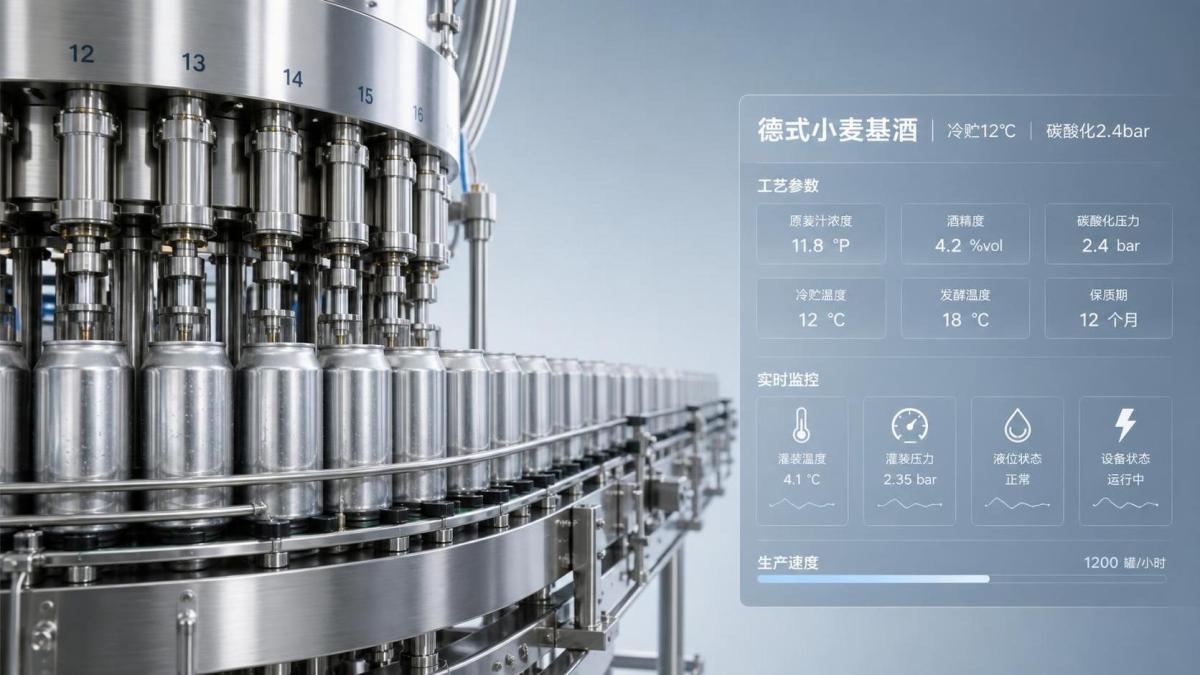
At Yangchun Beer’s 200-mu production site, the 16 production lines do not all operate at full capacity. Under normal conditions, 20%–25% of tank capacity and filling hours are reserved as a flexible buffer specifically for peak-season insert orders. This is not achieved simply by relying on overtime work; instead, more than 300 mature beer formulation processes have been broken down in advance into standardized modules: yeast activation time, cold storage temperature gradients, and carbonation pressure parameters are all fixed and archived. When a new order arrives, the corresponding module combination only needs to be retrieved, eliminating repeated trial brewing and validation procedures.
Confirming Three Types of Safeguards Is More Important Than Discussing Price
If you are handling a similar situation, it is recommended that you directly ask the OEM factory to confirm the following three items during an on-site visit or initial discussion:
- Production scheduling transparency: Can it provide a rolling production schedule view for the next 3 months? This should not be merely a delivery commitment, but visibility into the current occupancy status of each tank group, the volume of orders already locked in, and the remaining available windows for insert orders. Truly flexible production scheduling incorporates even small orders starting from 1 keg into a unified scheduling system, rather than recording them manually in Excel.
- Beer formulation reuse capability: Does it have a sufficient reserve of mature base beer formulations? For example, if you want an elderflower-flavored wheat beer and the factory already has both a German-style wheat beer base and an elderflower infusion process as backups, it can produce a sample within 7 days; if each flavor requires a small-scale trial from scratch, peak season will cause a delay of at least 3 weeks. This is where the value of 300+ process reserves lies.
- Multi-region response capability: Does it have coordinated production capacity across different locations? For example, when customers in East China need to meet the National Day sales period and the Shandong facility is at full capacity, can similar production lines in Qinghai or Hainan be deployed to take on part of the order? This not only shortens logistics distances but also disperses sudden risks caused by weather, power supply, or policy factors in a single production region.
These are not merely theoretical considerations. Supporting SC production qualifications and ISO9001 and HACCP systems ensure that every changeover, every batch of ingredients, and every label version has complete traceable records. Export food filing qualifications mean that its quality control standards have passed customs-level review, which is particularly important for overseas customers.
Do Not Overlook the “Invisible” Delivery Support
Peak-season delivery is not just about “filling beer into bottles”; it also includes label compliance review, packaging material compatibility, warehousing and sorting, and logistics coordination. Some factories can fill products but often get stuck at food and drug regulatory compliance when reviewing label artwork; some can produce aluminum bottles but lack the corresponding bottle-cap torque testing equipment; others have warehouse temperature and humidity conditions that do not meet requirements, causing cartons to soften and labels to wrinkle. These details can all amplify into delivery delays during peak season.
Global Craft Beer OEM Network (ODM.BEER) incorporates packaging compliance reviews at the initial stage of order launch, with dedicated personnel coordinating local market regulatory requirements; all packaging material specifications (cans, glass bottles, aluminum bottles, tinplate kegs, and PET kegs) have undergone actual filling tests, with parameter records retained; the intelligent warehousing system automatically sorts goods by order destination and supports mixed shipments to multiple addresses under a single order. These are not add-on services, but inseparable components of the delivery chain.
Finally, a reminder: the two months before peak season are the critical window for confirming production capacity. Many buyers wait until sales data is available before placing orders, only to find that base beer capacity for popular beer types has already been fully scheduled. Based on historical sales patterns, it is advisable to lock in base beer production capacity 60 days in advance, then gradually release specific packaging and quantity requirements according to actual sales performance. This avoids idle resources while safeguarding the delivery baseline.
Ultimately, there is no one-size-fits-all answer to the question, “Can beer OEM factories guarantee production capacity during peak season?” It depends on whether a factory has designed its processes around “uncertainty” as a normal condition, rather than treating peak season as an exception requiring last-minute firefighting. What procurement personnel need is not the “largest” factory, but a partner that treats scheduling as a product, beer formulations as modules, and multi-location production capacity as a network to be operated. Only then, when a sales colleague sends that message again—“We need 300 cases next week”—can you look at the production schedule and calmly reply: “It is already in the plan and will be dispatched on time.”