

Are Peak-Season Order Delivery Delays Common? 5 Practical Indicators for Assessing Capacity Flexibility at Beer Contract Manufacturers
In the beer contract manufacturing industry, peak-season delivery delays are not a question of “whether they happen,” but a dividing line between “who can handle the pressure and who gets stuck.” This is especially critical for small pub owners, emerging beverage brands, and corporate gift procurement managers. When the June–August craft beer consumption peak overlaps with the stock-up window for two major holidays, any breakdown in delivery can mean missing the prime sales season at best and damaging end-market trust at worst. Rather than discussing theoretical models, this article draws on Yangchun Beer’s 39 years of craft beer contract manufacturing experience to identify five practical indicators that can be verified on site, checked by phone, and agreed upon in advance in contracts—helping you quickly determine whether a contract manufacturer is truly reliable during peak season.
I. “16 Fully Automated Lines” Does Not Mean 16 Times the Capacity: Assess Production Line Changeover Flexibility
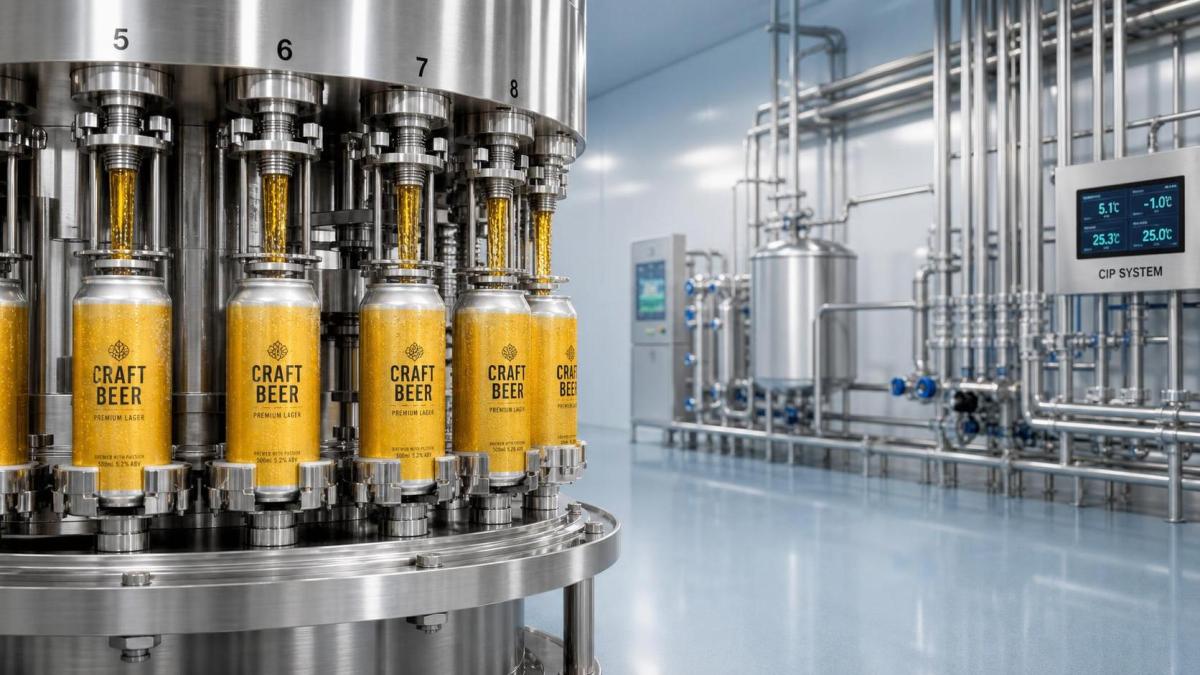
Many customers feel confident placing an order when they see “16 fully automated intelligent brewing and filling lines,” but the real bottleneck is often the “changeover cost.” For example, if you order 5,000 cans of fruit-flavored craft beer and the adjacent customer has just completed a German-style wheat beer run, a cleaning + material change + calibration process taking 48 hours will push the peak-season schedule back by three full days. Truly flexible factories are equipped with modular CIP systems, quick-release yeast tanks, and multi-format shared-line filling adapters. All Yangchun Beer production lines can complete a full process changeover from low-alcohol fruit beer to high-foam wheat beer within 72 hours, with a changeover loss rate of <1.2%—this is not a promotional claim, but measured data from SC audit reports.
Practical advice: Before signing a contract, request samples of the past three months’ Production Line Changeover Log. Focus on how frequently the same line completes ≥3 changeovers between different beer bases/packaging formats within seven days.
II> Beer Base R&D Cycle ≠ Waiting Time: The “Parallel Launch” Mechanism for ODM Customization
“How long does beer ODM beer base R&D generally take?”—the standard answer is 30–90 days, but the expert approach is to “produce samples and scale up simultaneously.” For chain pub customers, we use a “three-stage parallel approach”: in Week 1, determine the base beer style, such as a West Coast IPA framework; in Week 2, simultaneously conduct flavor enhancement testing (mango/passion fruit ratios), preliminary label compliance review, and small-batch blank can sampling; in Week 3, initiate production of the first order of 500 cases of the basic version. Once the final flavor is confirmed, production transitions seamlessly to upgraded-version filling. This truly integrates the R&D cycle into the order fulfillment process.
Can zero-sugar, zero-fat beer be custom manufactured? Certainly, but the key lies in process redundancy. Yangchun has led the drafting of the Zero-Sugar Zero-Fat Beer Group Standard. Of its proprietary library of over 300 mature beer bases, 27% are formulations with no added sugar/fat, and 12 products have passed full-item SGS testing. Customers simply select a formulation and make fine adjustments, without needing to develop from scratch.
III> Startup Costs for Small Pubs: It Is Not “How Much,” but “What the Money Is Spent On”
“How much does it cost for a small pub to launch its own beer brand?”—the quotation may state “minimum order starting from 1 keg,” but hidden costs are often overlooked: beer base adjustment fees, label design copyright fees, SC filing agency fees, and cold-chain logistics premiums for the first batch. We operate factories in Shandong, Qinghai, and Hainan, allowing small pubs to select the nearest facility based on their end-market location. For customers in East China, shipments go through the Shandong warehouse. For a first order of 500 L (≈1200 cans), including beer base customization + aluminum bottle packaging + basic quality control + direct provincial cold-chain delivery, the total cost is controlled within RMB 82,000, with installment payment supported (30% initial payment, 40% upon sample confirmation, and the balance settled before shipment).
More importantly, there is “post-launch sustainability”: we provide the first 100 pub customers with a complimentary channel operations package, including store-specific price tag templates, consumer education scripts, and a Douyin short-video script library—so that the first glass of proprietary beer can truly be sold, rather than merely displayed on the bar as decoration.
IV> Formula Autonomy: It Is Not “Whether You Can Choose,” but “Whether You Can Modify It After Choosing”
“Can I choose the beer base formula for beer ODM contract manufacturing myself?”—90% of contract manufacturers will answer “yes,” but their contracts contain “formula lock-in clauses”: once mass production begins, adjusting parameters requires new sampling and additional charges. Yangchun adopts a “dynamic formula authorization” model: customers retain ownership of the original formula, and every fine adjustment (such as bitterness ±5IBU or alcohol content ±0.3%vol) is included in the annual complimentary service allowance (new customers receive three free iterations in their first year). This is supported by our in-house AI flavor database and a team of 20 brewers—it does not mean allowing customers to make arbitrary changes, but using professional judgment to assess feasibility.
This also explains why we have served more than 1,000 brands: customers have the confidence to continuously iterate their products, and we have the confidence to invest in long-term process optimization.
V> The Ultimate Measure of Capacity Flexibility: Look at Off-Season Capacity Utilization
Whether operations remain stable during peak season depends on how diligently a factory “trains” during the off-season. A factory that operates at full capacity year-round will inevitably face capacity crowding during peak season; a truly flexible contract manufacturer, however, proactively maintains around 30% off-season capacity redundancy for process upgrade testing, new equipment commissioning, employee skills rotation training, and urgent order insertion. Every March–April (the traditional off-season), Yangchun Beer automatically releases four production lines to handle small-batch innovative trial orders. This ensures peak-season responsiveness while allowing customers’ new products to “start with small trials and then scale up”—which is the most responsible approach to managing customers’ capital.
What are the future prospects for the craft beer contract manufacturing industry? The answer lies not in macro forecasts, but in micro-level actions: when leading contract manufacturers begin using off-season capacity to incubate customers’ new products, using group standards to drive industry upgrades, and using multi-regional layouts to mitigate logistics risks, this sector has already moved beyond the initial stage of “whether contract manufacturers exist” and entered the deeper stage of “who can better grow alongside brands.”
In summary, when assessing a beer contract manufacturer’s peak-season delivery capability, do not simply ask, “Can you guarantee it?” Instead, focus on five hard indicators: whether production lines can switch quickly, whether R&D can be integrated in parallel, whether small-batch costs are transparent, whether formula adjustments are flexible, and whether off-season capacity has sufficient reserve. These are not concepts in a PPT presentation, but facts you can verify with a phone call, a document request, or a factory visit. True capacity flexibility is not found in the numbers, but in the details—and details are precisely what Yangchun Beer has refined every day for 39 years.