

How Much Does It Cost for a Small Pub to Launch Its Own Beer Brand?
We hear this question at least three times a day in the reception room at Yangchun Beer—not from distributors, but from small pub owners sitting behind the bar with malt crumbs still on their hands. They do not ask, “Can it be done?” Instead, they pull up a photo of the beer menu they have just taken on their phone: “I want to add a beer of my own, but I do not want to hold inventory, and I do not want to get called in by the market supervision authority for getting the label wrong.”
In 2026, the threshold for small pubs to build their own beer brands is no longer about “whether it can be done,” but “whether it can be kept under control.” It no longer depends on whether you have a brewer, but on whether you can bring the four elements of formulation, compliance, packaging, and first-order delivery into a closed loop within a controllable budget.
Do Not Be Misled by “Starting from RMB 10,000”: What Really Holds Back a Launch Is Hidden Costs
There are contract manufacturing services on the market quoted from RMB 30,000, as well as platforms claiming to offer “free design.” But three costs are often omitted from the actual accounting:
- Formula trial-and-error costs: A German wheat beer and an elderflower fruit beer differ entirely in raw material ratios, fermentation temperatures, and cold-conditioning time. Inexperienced pub owners often assume that “adjusting the flavor will do,” only to find that the first batch of samples has excessive acidity and turbidity. After two rounds of rework, they spend an additional RMB 12,000 on yeast and auxiliary materials alone;
- Label reprinting costs: China applies the dual standards of GB 7718 + GB 2758 to alcoholic beverage labels. There are mandatory requirements for ingredient list order, original wort concentration, shelf-life labeling methods, and warning statement placement. A pub in Qingdao once wrote “low alcohol” as “mild alcohol,” resulting in an entire batch of 2,000 cans being returned for relabeling;
- Minimum order quantity (MOQ) traps: Some factories state “starting from 100 cases,” but this is calculated by default based on 500ml glass bottles, which actually equals 1.5 tons. If a small pub cannot sell out its first order, inventory sits for six months and its capital turnover rate falls directly below the warning line.
These are not theoretical risks, but frequent issues among 17 real launch cases we handled at our Shandong and Hainan facilities over the past three months.
Breakdown of Basic Investment for Small- and Medium-Scale ODM Manufacturing in 2026 (Using a Single Craft Beer Product as an Example)
Back to the core question: how much does it actually cost? We break down a practical, ready-to-market launch package that avoids rework:
✅ Beer formulation development and sampling: includes 1 basic custom formula development session (such as bitterness adjustment and adaptation to local water quality), 3 rounds of flavor calibration, and 5L finished-product samples × 2 packaging formats (cans + glass bottles), with costs included in the launch package;
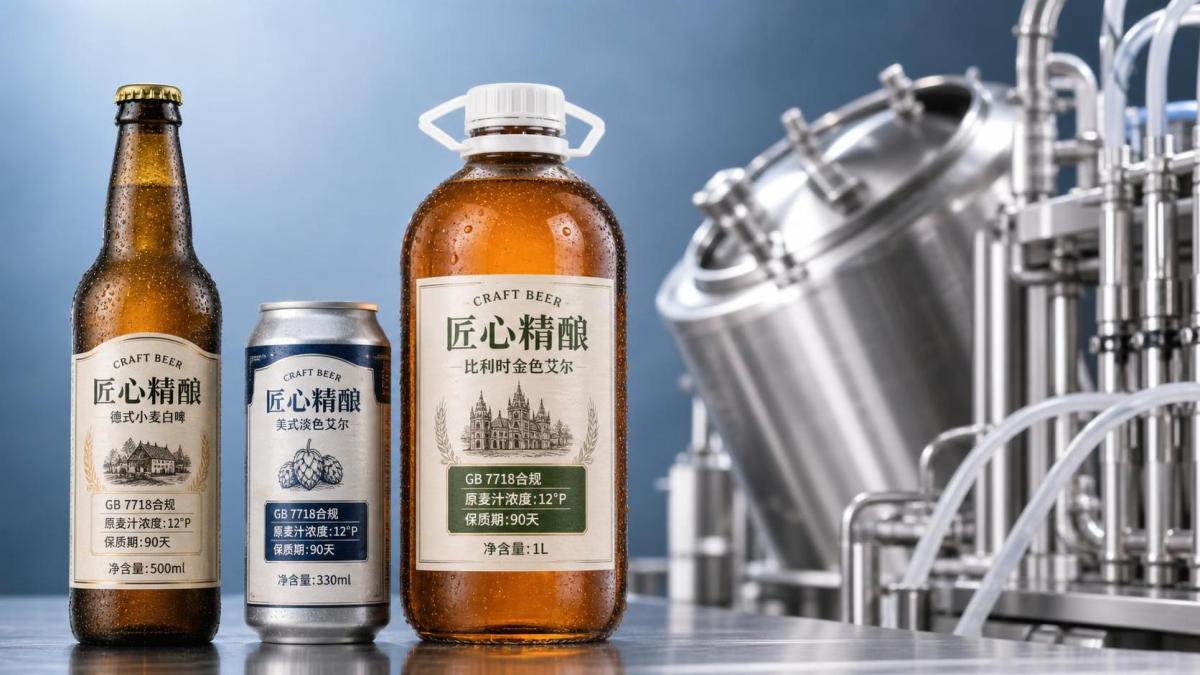
✅ Original packaging design support: provides 2 key visual concepts (including bottle, can, and coaster extensions), with designers coordinating throughout with the pub's spatial style rather than applying templates;
✅ Label compliance review: conducted item by item by a quality-control team holding SC certification, with a Food Label Compliance Confirmation Letter issued simultaneously to mitigate risks during distribution;
✅ First-order filling production: supports orders starting from 1 keg (10L), covering 6 formats including cans, aluminum bottles, and PET kegs, with video records retained throughout the filling process;
✅ Sample delivery: provides 3 finished beers in different formats free of charge, including cold-chain transportation, ready for drinking and evaluation upon arrival at the pub.
The standard price for this package in 2026 is RMB 88,000. It is not the “lowest price,” but a cost balance point established based on our 39 years of craft beer supply chain expertise, flexible scheduling capacity across 16 intelligent production lines, and a library of 300+ proven beer formulations—below this level, either development depth must be reduced or quality-control granularity must be compromised.
Why RMB 88,000 Rather Than RMB 50,000 or RMB 120,000?
Three industry realities lie behind this figure:
First, a formula is not flavoring. A private-label beer that truly drives repeat purchases must match the pub's customer profile: areas around universities favor low-bitterness fruit beers, regular customers in older urban districts tend to prefer the classic Pilsner profile, while industrial-style venues lean toward dark stouts. Our brewers first review the sales data for your top 3 monthly-selling beers, then work backward to determine the base beer logic. This labor input cannot be compressed.
Second, compliance is not just getting a stamp. Since 2025, market supervision authorities in many locations have conducted targeted spot checks on prepackaged foods sold directly through foodservice channels. A label error rate exceeding 12% triggers corrective action. What we provide is not merely a review; we incorporate requirements such as Article 4.3.2 of GB 7718, “the alcohol content declaration shall appear on the same panel as the ingredient list,” directly into the design draft checklist.
Third, minimum order quantity is not an arbitrary number. 1 keg (10L) = approximately 27 bottles of 500ml, enough for a small pub to run a two-week themed promotion, conduct bundle-sale testing with 3 food items, and collect feedback from 20 core customers. This is not a theoretical figure, but the sales threshold validated through testing at 12 partner pubs in Jinan, Chengdu, and Xiamen.
What Happens After Launch? The Real Turning Point Has Only Begun
Spending the money is only the starting point. We have seen too many pubs that, after a smooth first-order delivery, get stuck at the second step: they do not know how to clearly communicate what makes their beer unique.
For example, a sea salt wheat beer containing oyster peptides may simply be described by the customer as “refreshing,” while its actual umami flavor comes from the synergistic effect of oyster hydrolysate and wheat proteins—this information gap directly affects conversion rates at the point of sale. Therefore, we also provide support for writing Product Story Cards, translating process details into language customers can understand rather than piling up technical terminology.
In addition, warehousing and sales pacing need to be coordinated. Craft beer has a short shelf life, especially unpasteurized varieties. Based on the pub's average daily footfall, refrigerated cabinet capacity, and historical sales curves, we recommend phased filling schedules to avoid expiration losses caused by concentrated deliveries.
Your Next Step: Verify Whether You Are Ready
If you are on the verge of launching, ask yourself these three questions:
- Do you have a clear profile in mind for your “first beer”? Not merely “as long as it tastes good,” but “which type of customer do I want to order it, in what setting, and for what reason?”
- Have you confirmed the specific local market supervision requirements for foodservice operators selling prepackaged foods? (Some cities allow in-store portioning, while others require products to be prepackaged with complete labels.)
- Does your refrigeration equipment meet the storage temperature requirements for this beer? For example, a hazy IPA is best consumed at 4–6℃. If the pub's refrigerator is maintained above 8℃ year-round, flavor deterioration will accelerate by more than 40%.
There are no standard answers to these questions, but they determine whether RMB 88,000 is truly “money well spent.” We do not promise “guaranteed success,” but we can help you ensure that every cent is spent where it matters most.
If you already have some preliminary ideas, you are welcome to apply for a free beer sample tasting—not a few generic selections, but 3 targeted samples formulated according to the customer profile, venue, and positioning you describe. Taste them first, then decide whether to launch.