

At the early stage of a brand, when sales have not yet been validated through repeat purchases and channel payments are unstable, contract manufacturing is generally better suited to controlling the cost of experimentation. The value of building your own brewery can only be realized when sustained orders are sufficient to support capacity utilization and in-house production offers genuine cost or process advantages. You should not compare only “the cost of equipment” with “the cost per can from a contract manufacturer.” The real comparison is how much capital each option ties up, and what irreversible risks each entails, to produce and sell the same quantity of compliant products and collect payment for them.
Contract manufacturing does not mean there is no inventory risk, and building your own brewery does not automatically mean you will have better quality control. The former converts some fixed investment into purchasing expenses; the latter keeps production control within the company, along with idle equipment, workforce management, and compliance responsibilities.
The Most Commonly Overlooked Brewery Construction Costs Are Not the Brewing Equipment
A quote for brewing equipment is not the cost of a brewery capable of delivering consistently. In addition to the brewhouse and fermentation equipment, you also need to account for water treatment, refrigeration, steam or other heat sources, cleaning systems, filling and packaging, and testing facilities, as well as building modifications, drainage, and wastewater treatment. Power supply conditions, fire safety requirements, and the conditions for obtaining production permits can also affect whether the project can be implemented.
Packaging methods can significantly change the investment structure. Kegs, cans, and glass bottles are not simply different containers; each involves different filling, cleaning, sealing, and testing requirements. Buying brewing equipment first and adding a filling line later to meet channel demand can easily lead to capacity mismatches between upstream and downstream processes.
Building a brewery also means covering rent, staffing, and commissioning losses before production begins, as well as purchasing the first batch of ingredients, auxiliary materials, and packaging. Fermentation and maturation tie up tanks, while finished-goods inventory and channel payment terms continue to tie up cash. Construction funding and working capital should therefore be calculated separately. The scale of the first production run should not be decided by “how much money is left after paying the final equipment installment.”
Standardize Costs Around “Liters of Beer That Can Be Sold”
For contract manufacturing quotes, clarify whether the price includes the beer, packaging, design and plate-making, testing, transportation, and taxes, and standardize the alcohol content, ingredients, specifications, and delivery location. The price of unpackaged beer cannot be directly compared with a price that includes packaging and delivery to your warehouse. Nor should the sampling fee for the first order be treated as a cost incurred with every batch.
For in-house production, factor in ingredients and auxiliary materials, packaging, energy, direct labor, and losses, as well as annual fixed costs such as depreciation, fixed staffing, maintenance, and facilities. Do not allocate fixed costs based on the rated capacity on equipment nameplates; instead, use projected saleable volume that reflects the actual product mix and sales capacity.
A simplified calculation is: Annual break-even sales volume = Annual fixed costs of in-house production ÷ (Landed unit cost of contract manufacturing − Comparable variable unit cost of in-house production). Both sides must use the same assumptions for packaging, logistics, and taxes. Variable distribution costs must also be included in in-house costs. If the denominator is not positive, increasing sales volume cannot demonstrate that building a brewery offers a cost advantage.
For arithmetic illustration only: assume annual fixed costs of RMB 1.2 million and in-house savings of RMB 2 per liter. The break-even sales volume would be 600,000 liters. This is not an industry quote or an investment threshold. If the actual savings are only RMB 1 per liter, the break-even volume rises to 1.2 million liters; financing costs, the production ramp-up, and equipment replacement will further change the result.
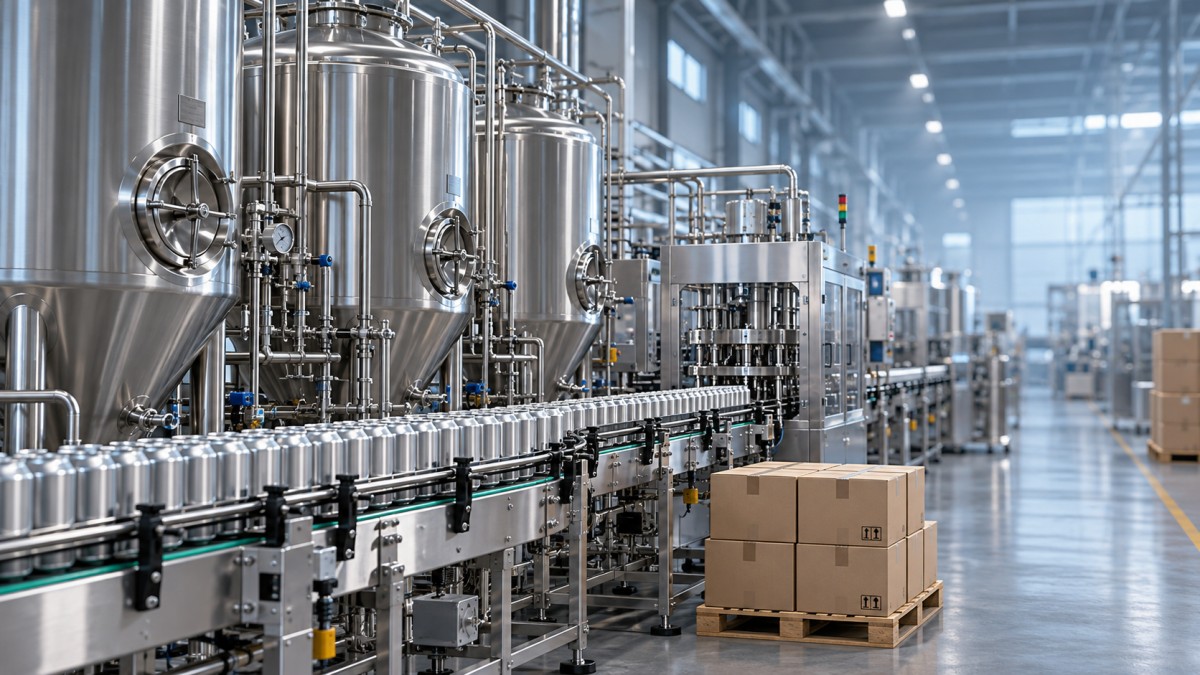
The same annual volume does not necessarily mean the same production efficiency. Multiple recipes, different tank formats, and frequent changeovers between small batches can increase cleaning, line changeover, and packaging-material requirements. Seasonal concentration of sales can also lead to insufficient capacity during peak periods and idle equipment during off-peak periods. A brewery investment model should be calculated by month and product mix, rather than based only on an annual average.
Contract Manufacturing Reduces Fixed-Asset Investment, but May Not Reduce Working Capital Requirements
Break down the minimum order quantities for contract manufacturing and ask about each one: the minimum production batch for the beer, the minimum order quantity for each packaging design, and the minimum filling run may all be different. The ability to fill small batches does not mean that custom-printed cans, bottle labels, or cartons can also be procured in small quantities. Before placing an order, specify in writing who will store the remaining packaging materials, how long they will be used for, and who will bear the cost if the design changes.
The time between payment and sales proceeds deserves particular attention. Deposits, final payments before dispatch, warehousing, and transportation costs arise first, while channel payments come later. If you order too much at once to lower the unit price, contract manufacturing can also lead to excess inventory. Compare the period during which the product can be sold within its shelf life, rather than looking only at the remaining shelf life when it leaves the factory.
During new-product testing, an order with a slightly higher unit price but a manageable batch size may conserve more cash than a large order at a lower unit price. This only makes sense if the landed gross margin on the small batch still covers channel costs—not if you accept a unit economics model that incurs long-term losses just to reduce inventory.
Quality-Control Risks Do Not Disappear; Only the Method of Control Changes
In-house production means you can adjust production schedules directly, but consistent flavor still depends on personnel, sanitation management, yeast management, and filling controls. Dissolved oxygen, microbial contamination, sealing defects, or mismatched storage and transportation temperatures can all cause problems with beer that passed inspection at the factory during its shelf life. Owning the equipment is no substitute for a quality management system.
With contract manufacturing, approved samples need to be translated into enforceable acceptance criteria: recipe version, key physicochemical indicators, sensory standards, packaging seal requirements, retention-sample rules, and batch traceability records. Approval of a sample does not automatically mean that mass production will pass. You should also specify sampling and inspection methods, the period for raising objections, and how nonconforming batches will be handled and their costs allocated.
Supplier audits should verify that the production license and its permitted scope match the actual products. Management system certifications are not a substitute for legally required production permits. Contract manufacturing does not relieve the brand owner of food-safety-related obligations. Responsibilities for label review, complaint response, and recall coordination must also be clearly defined. Rights to use the recipe, approval of ingredient substitutions, and handover of documentation when cooperation ends should likewise be included in the contract.
When Is It Worth Switching from Contract Manufacturing to In-House Production?
A stronger case for building a brewery is not a single large order, but the ability to cover fixed costs even under conservative sales assumptions, stable repeat purchases of core products, predictable channel payments, and existing in-house production and quality management capabilities. If your commercial differentiation genuinely depends on a specialized process, you also need to verify that it can generate sufficient returns rather than merely add equipment complexity.
At the early stage, you can use contract manufacturing to validate the product, pricing, and repeat purchases, while retaining recipe documentation and the option to switch suppliers. Once continuous operating data can answer “how much will we sell, when will we sell it, and how long will it take to collect payment,” compare in-house production, continued contract manufacturing, or a combination of the two. The decision to make a capital-intensive investment should be based on cash flow that can withstand lower sales and delayed payments—not on low costs calculated at full capacity.