

What Is the Future Outlook for the Craft Beer Contract Manufacturing Industry? A Practical Decision Framework from a Procurement Perspective
If you are preparing the first craft beer product for a pub, trading company, or new brand, the real question is not "Is the industry outlook good?" but rather: Can I receive beer of consistent quality on time with this order? If I want to add a hyaluronic acid fruit beer next time, can the current contract manufacturer take the order, develop the formula, and ensure regulatory compliance?
Industry prospects are a macro-level narrative, while procurement decisions are a micro-level reality. Over the past three years, we have worked with a large number of customers: some faced stockouts during peak season because their contract manufacturer suddenly stopped production; some spent three months finalizing packaging only to be repeatedly delayed by label compliance revisions; others tested three fruit-flavored formulas and ultimately found that only one could be reproduced consistently. These are not questions of whether the industry has opportunities, but whether the contract manufacturer you choose can withstand real business pressure.
Production Capacity Stability Is No Longer About "Having Production Lines," but About "Responding Dynamically"
The most underestimated risk in craft beer contract manufacturing is equating "available capacity" with "reliable delivery." In fact, true production capacity stability is reflected in three areas:
- Flexible response capability: Can small-batch trial production orders, such as orders starting from 1 keg, genuinely be incorporated into the production schedule? Or must production wait until a full tank truck load is accumulated? Many factories claim to support small orders, but their actual schedules roll on a weekly or monthly basis, and new product commissioning may require waiting more than 2 months.
- Multi-line fault tolerance mechanism: If one filling line fails, can production switch seamlessly to a backup line? When raw material batches fluctuate, are there process redundancy solutions, such as minor adjustments to mashing parameters or yeast activation contingency plans, to ensure flavor consistency?
- Regional fulfillment flexibility: East China customers need to meet the Double 11 deadline, while the Hainan plant is still undergoing equipment maintenance; northern pubs urgently need replenishment, but the Shandong plant delays shipment due to logistics traffic restrictions. No matter how large a single production base is, it is difficult to meet delivery-time requirements across all scenarios.
This is why an increasing number of procurement leaders are paying attention to whether contract manufacturers have a multi-regional footprint. This is not for the sake of "large scale," but to enable orders to be quickly transferred to another facility when extreme weather, policy adjustments, or supply chain disruptions occur in one location, preventing the entire sales chain from coming to a standstill.
The Core of Technological Iteration Is Not "New Concepts," but "Implementable Process Know-How"
The market often hears concepts such as "collagen beer," "prebiotic wheat beer," and "cold brew coffee IPA"... But what procurement professionals truly need to assess is: Is this innovation merely a laboratory PPT, or is it a mature process that has completed 5000L mass-production validation?
The value of technological iteration never lies in the gimmick itself, but in whether it solves real pain points:
- Fruit-flavored craft beer is prone to oxidation and off-flavors? — Check whether triple standards have been established for juice addition timing, cold-processing temperature, and oxygen control during filling;
- Low-sugar products have a thin mouthfeel? — Check whether different enzymatic process combinations, such as β-glucanase + limit dextrinase, have been developed to balance residual sugar and body;
- Functional ingredients, such as oyster peptides and hyaluronic acid, separate or become inactive after addition? — Check whether 6-month shelf-life stability testing has been completed, rather than only a 7-day accelerated test.
For a production base with a reserve of more than 300 mature beer formulation processes, its value is not in "how many varieties it can produce," but in the fact that each has undergone at least 3 pilot-scale trials, 2 customer blind tastings, and 1 full-cycle storage validation. This accumulation transforms new product development from "betting on a formula" into "selecting parameters."
Three Essential Conditions Most Often Overlooked in Procurement Decisions
When initially screening contract manufacturers, many customers focus on qualification certificates, equipment photos, and sample taste. However, the factors that truly determine the success or failure of cooperation are often the following three practical conditions that are easily overlooked:
- Early-stage label compliance review capability: This does not mean reviewing the label after the design is complete, but becoming involved during the packaging design stage. For example: Does the wording of functional claims trigger the regulatory boundary for health foods? Does the importing country define "alcohol-free" as requiring ≤0.5%vol? If such issues are discovered only after packaging materials have been printed, the losses involve both time and sunk costs.
- Match between the scope of the SC certificate and requirements: An SC license clearly specifies the approved categories, such as "beer (pasteurized beer, draft beer)," and packaging formats, such as "cans, glass bottles." If a customer wants fruit beer in PET kegs but the factory's SC certificate does not include registration for PET materials, it cannot be legally produced. This is not a question of "whether it can be made," but "whether it can be sold."
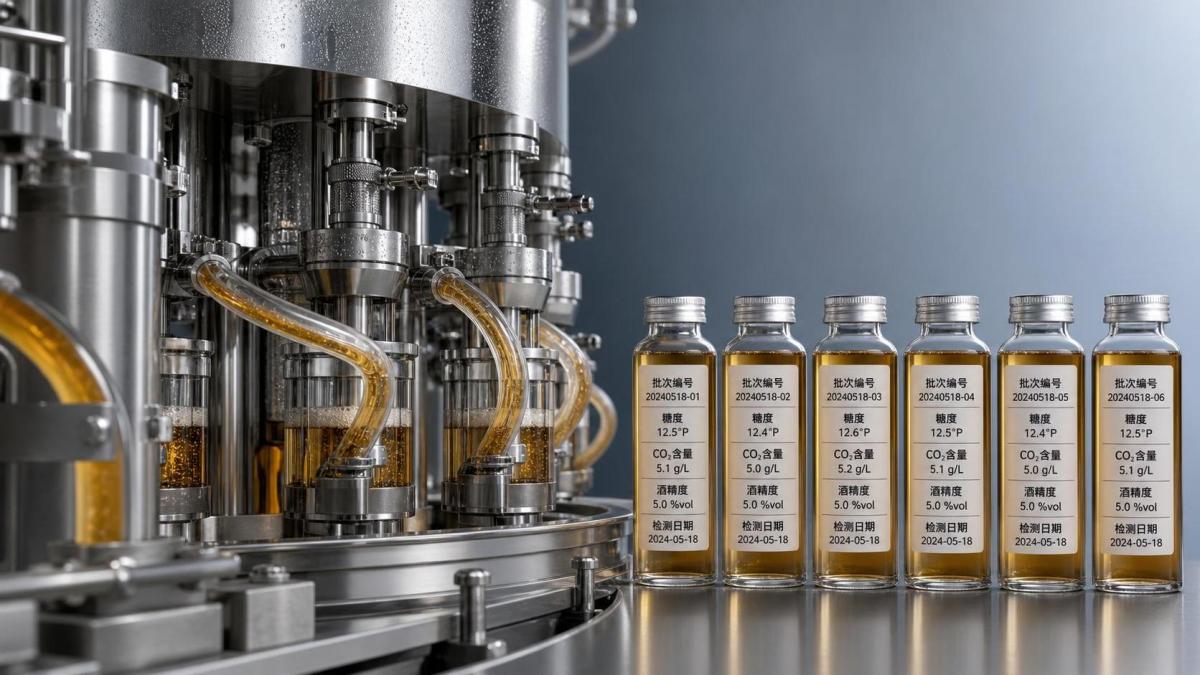
- Quality control standards for small batches: Large-volume orders can be tested by sampling, but how can orders below 1 ton ensure that the microbiological indicators, carbon dioxide content, and color values of every batch meet standards? Are online monitoring modules equipped? Is there a dedicated small-batch retained-sample storage facility? These details often determine whether the first shipment can successfully pass channel quality inspections.
When Is It Worth Choosing a Deep-Customization Contract Manufacturing Partner?
If you meet any of the following conditions, it is advisable to prioritize contract manufacturers with full-chain capabilities:
- You plan to build an own brand, rather than pursue short-term private labeling;
- Your target channels have clear requirements for flavor uniqueness, ingredient safety, and packaging differentiation, such as boutique pubs, premium supermarkets, and cross-border platforms;
- Your team lacks brewing technical expertise and needs substantive support from the partner in formula development, process adaptation, and regulatory interpretation;
- Your sales rhythm fluctuates significantly, requiring flexible fulfillment capabilities of orders starting from 1 keg + 72-hour rapid response + multi-warehouse distribution.
In this case, "contract manufacturing" is essentially an extension of the supply chain. The selection criteria are no longer the lowest quotation or the shortest lead time, but whether the partner can become the "invisible brewing partner" behind your brand—understanding market trends while upholding process standards; capable of launching new products while ensuring the stability of existing products.
Recommended Next Steps
Rather than broadly searching "What is the future outlook for the craft beer contract manufacturing industry?", take the following three actions immediately:
- Define the key constraints of your first order: Must it be ready for a specific trade show? Do 3 SKUs need to launch simultaneously? Or does a "zero sugar, zero fat" positioning require advance registration? List the hard requirements first, then screen factories that can meet them;
- Request complete process records for actual small-batch orders (not sample orders): including production schedules, in-process inspection forms, factory test reports, and logistics proof of receipt—see how they handle "non-standard orders";
- Apply for beer samples for tasting, but add one requirement: Request samples of the same beer from 3 different production batches, spaced ≥15 days apart, and conduct a blind tasting to assess flavor consistency. This is the most straightforward validation of production capacity stability.
Industry prospects are built from countless real decisions like these. Choosing the right contract manufacturing partner is not a bet on the future; it is about securing certainty for every shipment today.