

To reduce batch-to-batch flavor variation, breweries need to control fermentation temperature, the progress of sugar reduction, and the maturity endpoint in coordination. The same setpoint and fermentation duration do not mean that the yeast has undergone the same metabolic process. An actionable control standard should specify the beer temperature profile, phase-transition criteria, sampling method, and release criteria, so that each batch enters the next phase in a comparable physiological state.
Standardize the fermentation starting point for comparable temperature profiles
When the same recipe ferments at different rates, the cause may already be present at the time of transfer to the fermentation tank. Original wort gravity, fermentability, oxygenation level, yeast pitching rate, and yeast vitality can all affect heat generation and flavor compound formation. Tracking tank temperature alone can lead to differences in yeast condition or wort composition being misdiagnosed as cooling problems.
Batch records should link the wort transfer temperature, time to fill the tank, viable cell count at pitching, yeast generation, and oxygenation results. For staged wort additions, the time and temperature of each addition should also be recorded. Fermentation may already have started in the first wort addition, while subsequent additions will still change the tank’s heat load. To compare batch profiles, the time zero must be standardized to avoid mixing up “time after pitching” and “time after the tank is full.”
Control the beer temperature, not just the setpoint
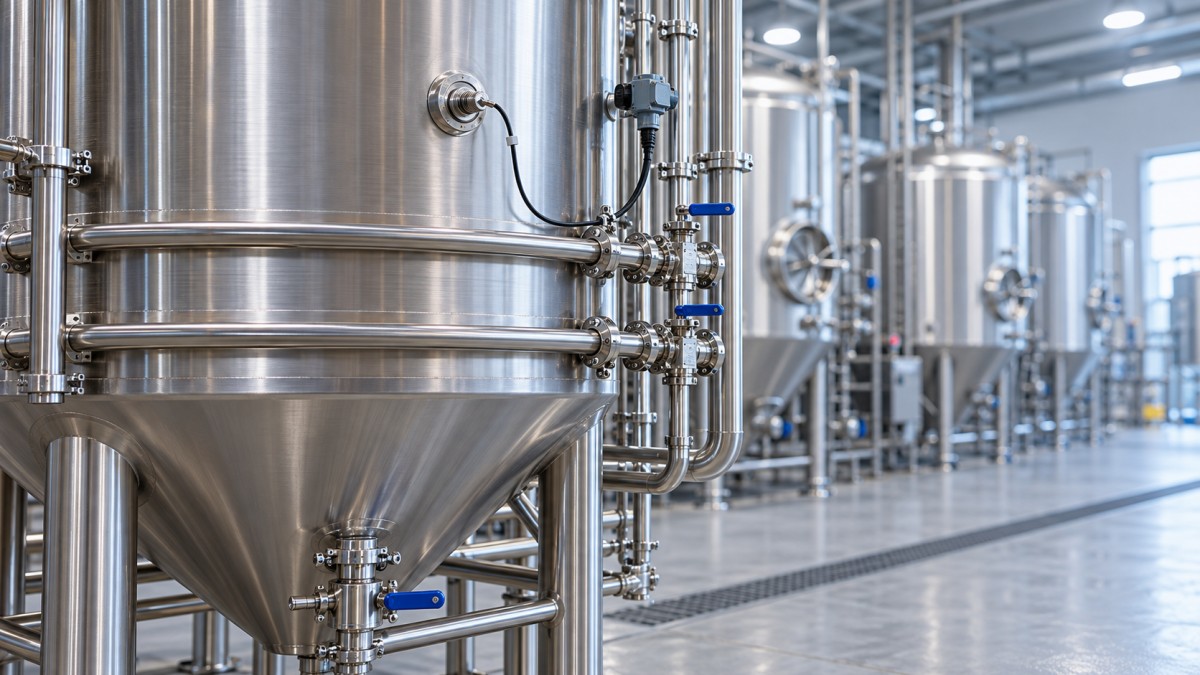
During vigorous fermentation, heat is continuously generated. A temperature control interface showing that the target has been reached does not prove that the temperature is uniform throughout the tank. Probe location, fill level, tank dimensions, jacket zones, and coolant supply capacity all affect measurement results and the actual temperature distribution. If the area near the probe cools first while other parts of the tank remain warm, local temperature deviations may go unnoticed.
Temperature control should be based on validated beer measurement points, with temperature differences between locations checked at representative fill levels and under vigorous fermentation conditions. In addition to calibrating probes, monitor valve operation and temperature response. If a valve remains open for an extended period but the temperature does not fall, investigate coolant supply, heat-transfer conditions, or heat load. If the temperature repeatedly crosses its upper and lower limits, check the control differential, tuning parameters, and probe response.
The temperature profile can be divided into pitching adaptation, primary fermentation, late maturation, and cooling, but temperatures in each phase must be matched to the yeast strain and beer style. Higher temperatures change the fermentation rate and also affect the formation of compounds such as esters and higher alcohols. Subsequent cooling cannot directly eliminate flavor deviations formed earlier. Therefore, in addition to an upper temperature limit, set limits on the duration of deviations and the rate of temperature change to prevent short-term overshoots from being masked by daily averages.
Base phase transitions on the progress of sugar reduction
Scheduling “raise the temperature on day X and lower it on day Y” is convenient when raw materials and yeast condition are stable. However, if fermentation runs early or late, the same operation will occur at a different metabolic stage. A more reliable approach is to use apparent extract or changes in density as the primary guide, and assess the timing of transitions in conjunction with temperature, tank pressure, and sensory condition.
Raising the temperature late in fermentation promotes maturation and requires yeast that is still active. Switching too early changes the flavor-formation conditions while vigorous fermentation is still underway. Waiting too long, or removing a large amount of yeast prematurely, can reduce the yeast’s ability to reduce substances such as diacetyl later. Specific trigger points should be determined by yeast strain, original gravity, and historical conforming batches, and should not be applied indiscriminately across beer styles.
Tank pressure should also be included when comparing profiles. Pressure affects yeast metabolism and the release of volatile compounds. Even at the same temperature, different pressure-holding strategies may produce different aromatic profiles. For off-spec batches, do not simply apply the remedy “raise the temperature to accelerate fermentation.” First distinguish between measurement anomalies, insufficient yeast vitality, and differences in wort fermentability.
Fermentation completion and readiness for cooling are two separate determinations
Stable density only indicates that measurable sugar reduction is approaching a halt; it does not, by itself, prove that maturation is complete. Stable density may also result from a stalled fermentation. The assessment should be compared with the expected endpoint for the wort, and a forced fermentation test may be used, where necessary, to confirm the remaining fermentation potential.
Endpoint sampling should standardize the sampling location, degassing procedure, measurement temperature, and instrument method. Carbonated samples, residual liquid in the sampling port, or inconsistent temperature compensation can all create a false appearance of stability. The interval between successive measurements and the permitted range of change should be determined based on fermentation rate and method precision; instrument resolution should not be treated directly as a process acceptance limit.
Maturation release should also take diacetyl and its precursors into account. Cooling based only on the absence of an obvious buttery aroma in the current sample may lead to flavor problems when the remaining precursors are subsequently converted. A validated forced diacetyl test can be used, or total vicinal diketones that include the contribution from precursor conversion can be measured, with the results assessed against sensory evaluation and internal product limits. Results from different methods should be interpreted according to their respective criteria.
Turn deviations into traceable process evidence
Batch comparisons should retain actual temperature, setpoint, density, tank pressure, cooling valve operation, and records of manual intervention. In addition to temperature-limit alarms, identify stalled sugar reduction, unusual time to reach the target temperature, and maturation indicators that remain out of specification. Alarm limits can be established from the process distribution of conforming batches and reviewed against process tolerances. Historical maximum values should not be used directly as limits.
To evaluate control effectiveness, correlate process profiles with finished-product testing and blind tasting results. If ester aroma continues to deviate despite similar endpoint densities, review pitching, oxygenation, and early-stage temperatures. If maturation takes longer, focus on yeast condition, the timing of yeast removal, and late-stage temperature. Simply extending the time in the tank does not explain the source of a deviation.
After changing the yeast strain, adjusting original gravity, changing the tank type, or altering the fill volume, revalidate the phase-transition criteria. The existing profile can serve as a starting point for trials. Once consecutive batches demonstrate stable process and flavor performance, incorporate it into the formal process version and retain the rationale for the changes.