

After changing beer manufacturers, keeping the original recipe does not necessarily preserve the original taste. Water quality, yeast condition, heat transfer in the equipment, fermentation pressure, and oxygen pickup during packaging can all affect the finished product. A reliable changeover means turning the original product into a traceable flavor benchmark, then using process adaptation, trial production, testing, and blind tasting to confirm whether the new brewery can reproduce it consistently.
Consistent taste does not mean that every value must be exactly the same. What must be maintained are the aroma, bitterness, body, carbonation bite, and finish that consumers recognize, while also meeting food safety and product specification requirements. Passing alcohol content, original gravity, and color specifications shows only that some parameters are similar; it does not, by itself, prove flavor consistency.
First define “consistent with what,” then transfer the recipe
A single bottle of the old beer is not suitable as the sole benchmark: storage time, temperature, and transport conditions may all change its flavor. Select representative retained samples from different batches that were routinely released by the original manufacturer. Record production dates, packaging formats, and storage conditions, and compare samples at similar beer ages and the same serving temperature whenever possible.
The benchmark should also include sensory descriptions and acceptable variation ranges. For example, specify the balance between ester and phenolic aromas in wheat beer; for hop-forward beer, distinguish aroma intensity, bitterness intensity, and harshness of bitterness. Descriptions such as “rich malty aroma, refreshing taste” are not specific enough to guide adjustments by the new manufacturer.
Acceptance requirements should be clearly defined in advance: which parameters are hard constraints for safety or label compliance, which represent the brand’s core flavor, and which may vary slightly. Tolerance ranges should be established based on historical batches, the repeatability of test methods, and the ability to detect sensory differences; a generic set of tolerances should not be applied at the last minute.
Transfer not just the ingredient bill, but also the control conditions behind the recipe
Effective handover documentation should tell the new brewery “what to use, how to process it, and what condition to achieve.” Providing only ingredient names, weights, and fermentation days leaves many variables that cannot be reproduced.
- Raw material specifications: For malt, include relevant information such as color and extract yield; for hops, specify the variety, form, key batch parameters, and storage conditions; for juice, flavorings, and other adjuncts, retain their specifications, addition timing, and addition method.
- Brewing water: Record the quality of treated water, key ionic composition, alkalinity, and mash pH control. Requiring only consistent water pH does not ensure consistent mash performance or perceived bitterness.
- Yeast management: Specify the strain, basis for calculating pitching rate, viability requirements, generation used, and wort oxygenation conditions. Even the same strain can produce different ester and phenolic aromas and different degrees of fermentation when used in different conditions.
- Process records: Include the mash temperature profile, boil and hop additions, cooling, fermentation temperature and pressure profiles, cooling, conditioning, filtration or centrifugation, and key test results before and after packaging.
Also confirm the rights to use the recipe, confidentiality responsibilities for process documentation, and authority to approve raw material substitutions. If the original manufacturer cannot provide complete documentation, plan for R&D and validation under a “target beer reconstruction” approach rather than treating the task as direct replication; finished-product testing alone cannot reveal the entire process.
After changing equipment, align process outcomes rather than copying setpoints
The same mash time, boil duration, and hop dosage may not produce the same results on different equipment. Heating method, evaporation rate, and whirlpool residence time affect wort concentration, the conversion of bitter compounds, and the removal of volatile compounds. Adjust parameters based on target wort composition, fermentability, and bitterness rather than simply copying the operating sheet.
Fermenter height, fill volume, and pressure conditions affect yeast performance. During scale-up, assess progress using extract reduction, temperature changes, and maturation indicators such as diacetyl; do not transfer beer to the next stage solely because it has “fermented for a certain number of days.” For dry hopping, also check contact conditions, oxygen pickup, and subsequent fermentation changes.
Packaging must also be included in the handover. Dissolved carbon dioxide affects carbonation bite, while oxygen pickup during packaging affects aroma and aging rate; changes in filtration or pasteurization conditions may also alter the beer’s characteristics. Therefore, samples taken from the fermenter that are close to the original beer show only that the brewing stage is similar; they do not mean the final delivered product has passed validation.
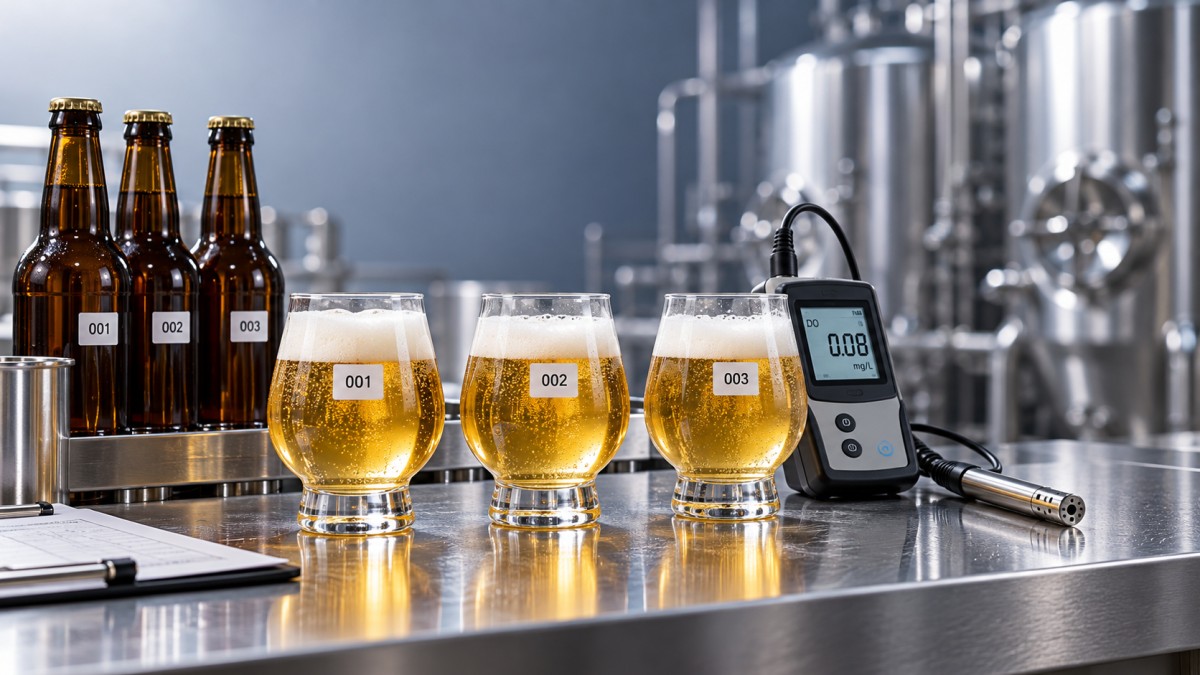
Trial production validation must use finished product in its actual packaging
Pilot-scale trials are useful for screening recipe and yeast options, but cannot replace production-line validation. Before the formal changeover, conduct a trial under the planned brewing, fermentation, and filling conditions, and retain samples from key stages. If differences arise, this makes it possible to determine whether they originated in the wort, fermentation, post-processing, or packaging.
Testing should cover basic physicochemical properties, microbiology, and process parameters related to flavor. In addition to alcohol content, original gravity, color, bitterness value, and pH, check fermentation level, carbon dioxide, diacetyl, dissolved oxygen, or total package oxygen as appropriate for the beer style and risk. Results from different methods cannot be used interchangeably. When comparing across laboratories in particular, first standardize sampling, sample preparation, and test methods.
Sensory validation should use coded blind tasting, with serving temperature, glassware, pouring method, and wait time after opening kept consistent. Triangle tests can be used to determine whether a perceptible difference exists, while descriptive evaluation can identify whether differences come from aroma, sweet-bitter balance, body, or finish. Failure to detect a significant difference does not automatically prove equivalence; the number of assessors, study design, and test capability must also be considered.
After fresh samples pass, stability should also be observed under representative storage and transport conditions. Accelerated testing can help screen for risks of oxidation, haze, and aroma loss, but should not replace real-time shelf-life observation without first establishing a correlation.
Turn trial production results into changeover release criteria
Passing a single trial production run is not enough to demonstrate consistent reproducibility. Before the changeover, agree on the requirements for confirming consecutive batches, enhanced testing for the first commercial production batch, and the conditions that trigger revalidation after changes to raw materials, yeast, equipment, or packaging processes.
If physicochemical parameters pass but blind tasting reveals a deviation, investigate along the sample chain rather than trying to “correct” it simply by adding flavoring, hops, or sugar. Retain the version, reason, and retest results for every adjustment. Only when the finished product in its actual packaging has been confirmed to meet requirements for core flavor, quality and safety, and stability is there a basis for moving from trial production to routine delivery.