

To determine whether a beer factory can deliver on schedule, compare the equipment on site, recent production records, and the order schedule. The number of machines only indicates the scale of the setup. What really matters is whether the planned beer and packaging can run reliably on the existing production line, when fermentation tanks will become available, and what inspections and release steps are required after filling. During the assessment, select a completed order with similar specifications, trace its production batch through to dispatch, and then verify the basis for scheduling the proposed order.
First, confirm which production line will handle the order
Clearly specify the beer type, packaging capacity, container format, batch quantity, and delivery date. The same beer packaged in glass bottles, cans, or kegs requires different filling equipment, sealing methods, and changeover preparations. These formats cannot be covered by a single capacity estimate.
Follow the actual production flow and inspect the fermentation tanks, bright beer tanks, filling machines, capping or seaming equipment, and the labeling, coding, case packing, and palletizing stages. If the product requires filtration or pasteurization, also confirm the relevant equipment and processing capacity. Even if the filler runs at high speed, a persistent backlog at the case-packing stage will still limit the delivery speed of the entire line.
Check whether the planned specifications already have compatible components and operating records. Changing bottle types may require adjustments to the guide rails, star wheels, and capping setup; changing can types may require adjustments to conveying, filling, and seaming. Simply saying that “the equipment can be adjusted,” without changeover validation and preparation time, is not enough to support a firm delivery date.
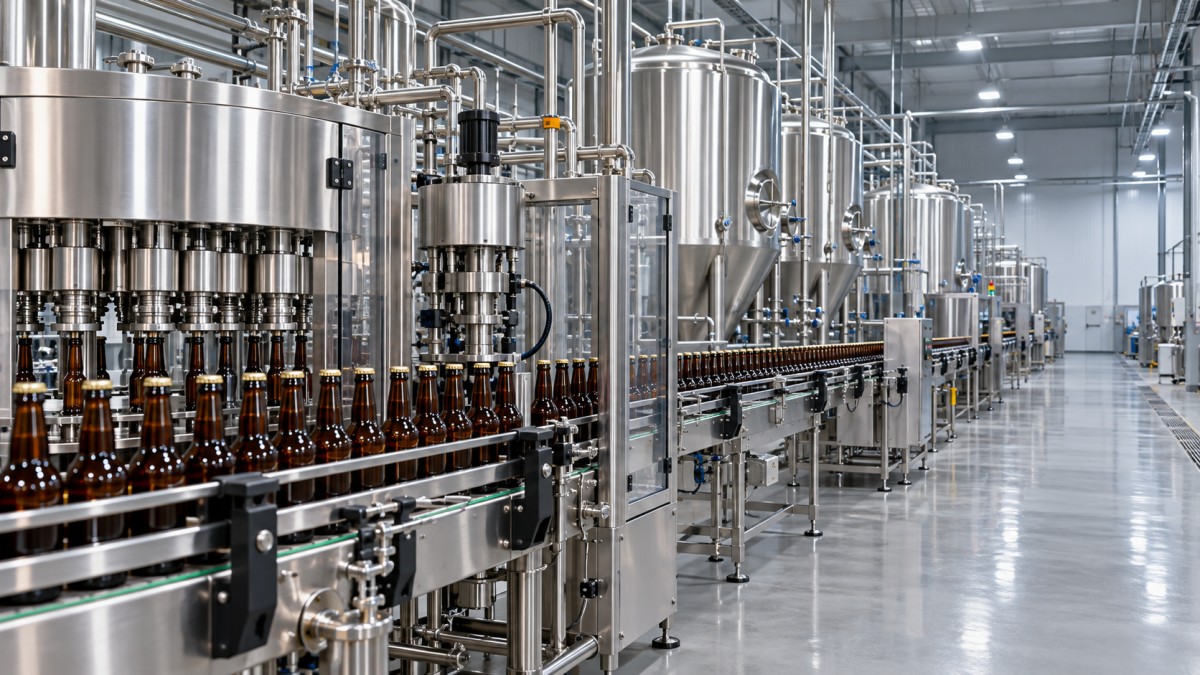
Calculate filling efficiency over a complete shift
The speed stated on the equipment nameplate cannot be multiplied directly by working hours to calculate daily output. More useful evidence is recent shift data for a similar beer and the same packaging specifications, including start-up time, good output, reasons for downtime, packaging losses, and changeover time. A smooth short test run does not demonstrate the ability to operate continuously for a full shift.
For the calculation, use: good output per shift = good output rate during stable operation × effective operating time. Effective operating time must exclude time spent on cleaning and sanitizing, changeovers, machine adjustment, breakdowns, and waiting for materials. If the average rate is calculated using good output for the entire shift, do not deduct the same downtime losses again.
Carbonation level, filling temperature, and foaming behavior all affect operating speed. Production data for a particular clear beer cannot directly demonstrate that a product containing fruit juice or other ingredients will achieve the same efficiency. Ask whether the planned beer has already been produced at commercial scale. If the recipe has not yet been validated, the schedule should allow time for a trial run and parameter adjustments.
To determine whether tank capacity is sufficient, check the occupancy cycle and release dates
An apparently spacious brewhouse does not necessarily mean that the factory can accept an order in the near term. Brewhouse equipment prepares the wort, while fermentation and conditioning continue to occupy the tanks. To assess available capacity, review the tank schedule for the coming period, taking into account the working volume of each tank, the process cycle for the beer, batches in progress, and cleaning schedules.
At the site, select a fermentation tank currently in use and match its tank number, batch, ingredient charging date, and estimated transfer date. Then check whether the related temperature, pressure, and test records support that timeline. The total tank volume cannot all be counted as deliverable beer; process headspace and production losses must also be taken into account.
Fermentation, conditioning, and ingredient processing times vary between beer types. If the delivery date depends on shortening the established process cycle, verify the supporting process validation. Bright beer tanks must also be included in the schedule: if beer waits for filling after transfer, it may occupy the tank space needed to turn over subsequent batches.
Link the records for the same batch into a traceable chain
Production records are valuable when they can be cross-checked. Select a recently shipped batch and verify whether the following records all refer to the same order, the same beer batch, and the corresponding packaging batch:
- Brewing and fermentation records: Raw and auxiliary material lot numbers, quantities charged, key process data, and transfer destinations should explain the origin of the beer in the batch.
- Filling records should correspond to the production date, line, packaging specifications, good quantity, and losses. Pre-filling cleaning and sanitizing records should cover the relevant equipment and pipelines.
- Inspection, release, and dispatch documents. In addition to finished-product test results, check whether any nonconformities were closed, whether release took place before shipment, and whether the dispatch quantity can be reconciled with the quantity accepted into finished-goods inventory.
Quantities in the records do not have to match exactly at every stage: sampling, residual liquid, and rejected packaging all create differences, but those differences should be accounted for. If batches cannot be linked, or only summary tables are available without the original records, it is difficult to use them to assess reliable delivery capability.
You can also review a record of how a shutdown or quality issue was handled. The occurrence of a breakdown does not by itself disprove the factory’s capability. Whether the time of discovery, scope of isolation, recovery validation, and schedule adjustments are fully documented is a better indicator of whether delivery dates can be controlled when issues arise.
The final delivery date should be supported by an executable production schedule
At a minimum, the production schedule should link beer preparation, packaging-material arrival, filling, inspection and release, and dispatch, and show capacity committed to existing orders. A verbal promise that production can be scheduled at any time, without clear information on tank availability, line assignment, and packaging-material status, cannot verify a delivery date.
For custom packaging in particular, verify the arrival dates and acceptance status of the materials. Having containers in inventory does not mean that labels, cartons, bottle caps, or can ends are all available as a complete set. First-time packaging also requires checks for dimensional compatibility and sealing validation; these tasks should be scheduled before full-scale production.
A backup production line can only be counted as contingency capacity once packaging compatibility, process conditions, staffing, and changeover time have all been confirmed. If additional production is promised at another facility, verify that facility’s actual schedule and transportation time; do not simply add together the stated capacities of multiple sites.
At the end of the assessment, document the conclusion in terms of specific milestones: the date when tank capacity will be available, the date when all packaging materials will be on hand, which line will handle filling, and when release will be completed and the order ready for dispatch. Any milestones still awaiting confirmation should have a named owner and a completion date. Once these conditions are in place, the delivery commitment will have a traceable basis.