

When a brewery switches from fruit-flavored, spiced, or heavily hopped products to a light-flavored beer, clear rinse water and equipment with no noticeable odor are not enough to prove that flavor carryover will not occur. Effective cleaning validation must demonstrate that the established cleaning procedure can remove residues that could affect the next product, with release supported by sampling tests and checks on the subsequent product.
Whether cleaning is acceptable cannot be judged solely by “how long it was washed.” It is also necessary to consider what the previous product left behind, where residues are likely to accumulate in the equipment, and how sensitive the next product is to them. Detergent residues and microbiological risks must also be controlled separately; a single smell test or one rapid test cannot replace the full assessment.
Choose the most challenging product changeovers
Cleaning validation does not need to repeat every possible product combination. Instead, group products by formulation, contact equipment, and cleaning difficulty, then select representative combinations that cover the risks within each group. Products with strong aromas, fruit pulp, oily flavor compounds, or more sticky residues generally warrant closer assessment. If the next product is a light-flavored lager, even a small amount of residue may be easier to detect.
A strong aroma does not necessarily mean a product is the hardest to clean. Some materials rinse away easily, while certain flavor compounds may adhere to materials such as gaskets and hoses and then be released slowly after cleaning. When selecting products for validation, consider residue adhesion and solubility, equipment contact time, and sensory impact.
Production can be scheduled from lighter- to stronger-flavored products to reduce high-risk changeovers, but this does not replace cleaning. Formulations containing milk or other ingredients requiring allergen management also need separate cross-contact controls. The absence of flavor carryover must not be treated as proof that allergens have been removed.
Select sampling points based on where residues may remain
CIP, or cleaning in place, relies on effective contact between the cleaning solution and equipment surfaces. An acceptable return solution does not mean that valve cavities, branch lines, and seals have all been cleaned. Before sampling, map the product-contact path from the storage tank through the transfer lines to the filler, paying particular attention to flavoring branches, sampling valves, hose connections, filling valves, and low points where liquid can collect.
Different sampling methods address different questions and should be used together:
- Final rinse water: Useful for checking soluble residues carried out of the system, but excessive water volume may dilute contaminants and mask local problems.
- Surface swabs: Suitable for accessible locations such as gasket grooves and valves. Standardize the swabbed area and confirm that the sampling material can recover the target residue.
- Subsequent product: Focus on the initial filling stage to determine whether residues cause a flavor deviation once they enter the actual beer.
Records should also specify the sampling location, time, and equipment status. “Collect water after cleaning” is too vague; results may differ depending on whether sampling occurs before or after draining, after a period of standing, or after restarting the system.
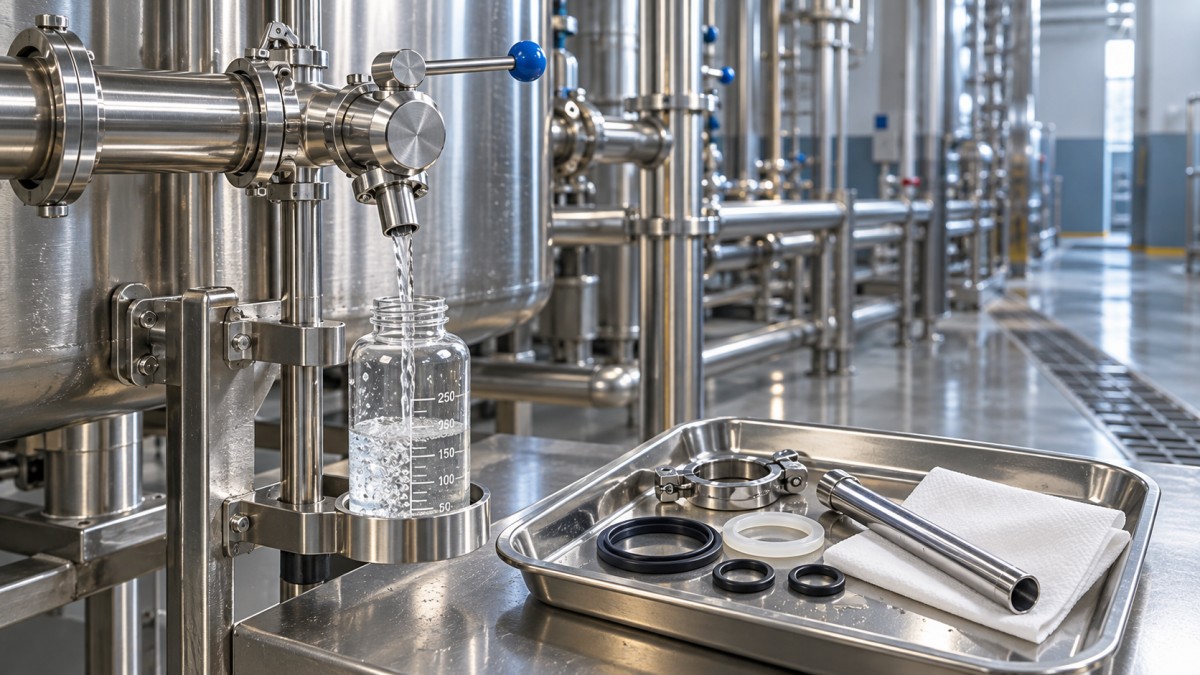
Choose test methods that answer specific questions
Sensory checks directly assess flavor carryover, but should not consist of having just one person smell the rinse water. Use odor-free sampling containers and suitable blanks or target beer as references, and evaluate under consistent conditions. Blind testing or triangle tests may be used where necessary, with acceptance criteria defined in advance. Aroma release and masking effects differ in the next beer, so an odor-free water sample cannot replace product evaluation.
Select instrumental or rapid tests based on the nature of the residue rather than simply adding more tests.
- Conductivity and pH: Can help determine whether acidic or alkaline cleaning agents have been rinsed away, but cannot directly prove that flavorings or oily substances have been removed.
- ATP: Can help detect organic contamination and cleaning abnormalities, but cannot directly identify residues of specific flavor compounds or serve as a substitute for microbiological testing.
- Total organic carbon or testing for characteristic compounds: The former can indicate changes in some organic residues; the latter is more targeted. For both, method suitability, recovery, and detection capability must be confirmed.
If a method cannot detect residues at levels that could affect flavor, a “not detected” result is not sufficient to support release. For substances that readily adsorb and have low odor thresholds, combine targeted testing with sensory evaluation of the subsequent product.
Set acceptance limits before validation
There is no universal “no flavor carryover” threshold for all flavored beers. Limits should be established based on the possible amount of residue transferred to the next batch, its sensory impact in the target beer, applicable food safety requirements, and test capabilities. Acceptance criteria must not be adjusted after seeing the results.
Controlled sensory tests using known levels of the previous product added to the target beer can help determine levels that are perceptible or unacceptable. If carryover is estimated from pipeline residue and the volume of the next batch, account for the possibility that the initial product may have a higher concentration; do not judge solely on the value after dilution across the entire batch.
Sensory acceptance, compliance of target residues with limits, removal of cleaning agents, and microbiological control should provide complementary evidence. Passing one criterion cannot offset failure of another.
Validate a fixed procedure and confirm that routine operations do not deviate
Before validation, define the type and concentration of cleaning agent, temperature, cycle time, flow rate or mechanical action, valve operation, and draining method, and confirm compatibility with contact materials. Also cover adverse conditions within a reasonable range, such as longer production runs, residues drying during downtime, and the lowest cleaning temperature permitted for the equipment.
One successful result is not enough to establish that a procedure is reliable; repeat runs must demonstrate reproducibility. Once the procedure is confirmed, routine changeovers should focus on checking that critical parameters meet requirements, with rapid checks, sampling, and release scheduled according to risk. After introducing a new formulation, replacing gasket materials, modifying pipework, or changing the cleaning procedure, assess whether the existing validation still covers the process.
If flavor carryover is detected, isolate the affected product and investigate causes such as retention points, parameter deviations, and material adsorption before deciding whether to clean again, inspect the equipment after disassembly, or replace components. Simply extending the rinse time may not solve the problem.
When outsourcing production involving flavor changeovers, request from the factory the validation evidence for the relevant product combination, sampling locations, acceptance limits, and records of abnormal-event handling. An explanation of “why this procedure is suitable for this changeover” is more useful for assessment than simply stating that “CIP has been completed.”